Listen to this article
0:00 / 3:57 · Read by ArtLogia
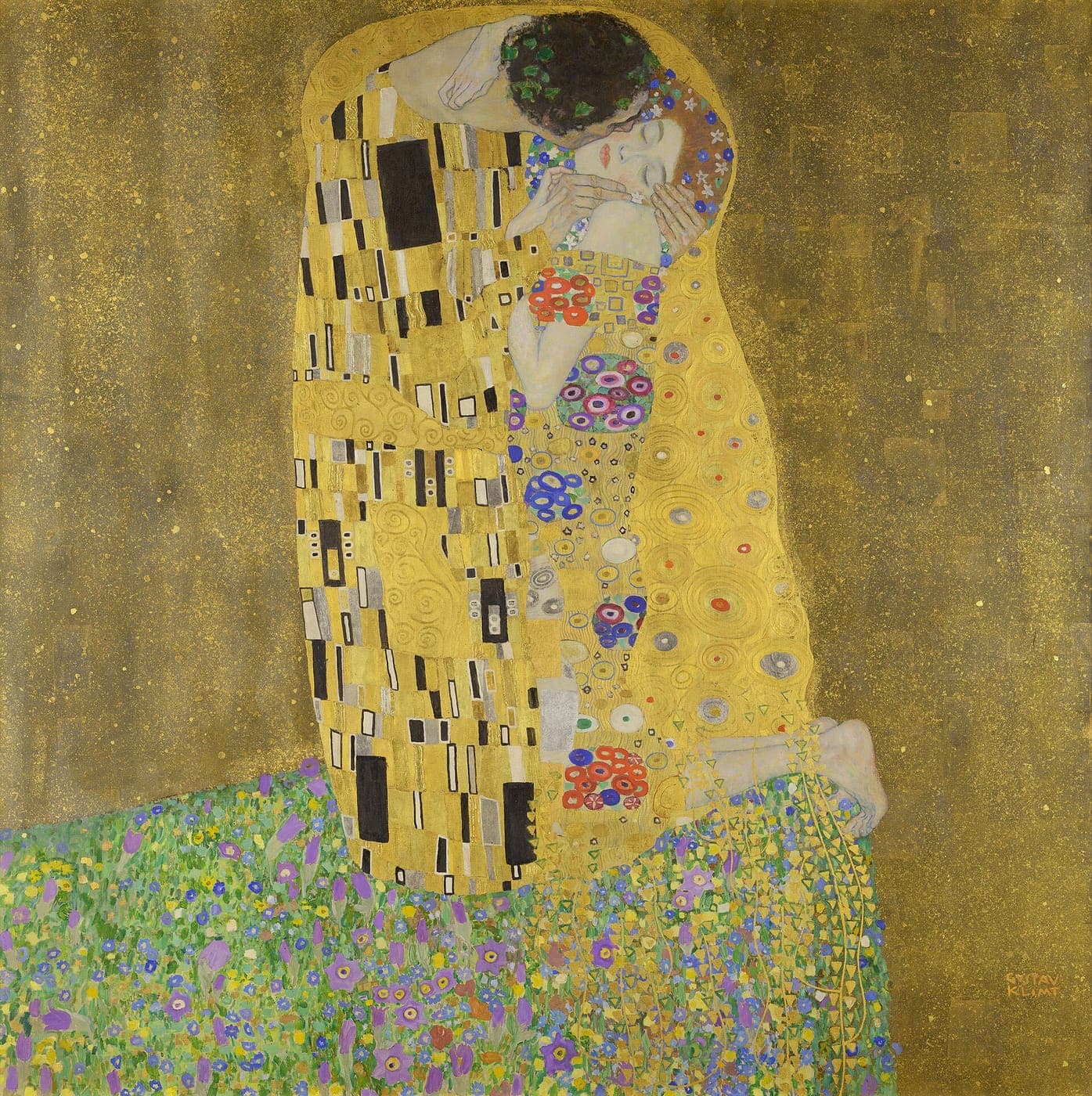
Two lovers embrace, wrapped in a single golden cloak, kneeling at the edge of a meadow of flowers. Gustav Klimt painted The Kiss in 1907–1908, at the height of his Golden Period, and the Austrian state bought it before it was even finished.
In this article
Vienna's golden icon
Gustav Klimt painted The Kiss in 1907 and 1908 in Vienna, at the peak of what is called his Golden Period. He had founded the Vienna Secession in 1897 with other young artists who rejected the official academy, and by 1907 he was both the most celebrated and the most controversial painter in the city. His paintings for the ceiling of the University of Vienna had been attacked as indecent, and he had withdrawn from public commissions.
The Kiss was first shown in 1908 at the Kunstschau, an exhibition organised by Klimt and his circle. The Austrian Ministry of Education bought it for the Belvedere during the exhibition, for an extraordinary price, before it was even considered finished. It has never left Vienna since.
Gold leaf and Byzantine mosaics
The shimmering surface of The Kiss is made with real gold and silver leaf applied to the canvas, combined with oil paint. Klimt's father was a gold engraver, and Klimt had trained in a school of applied arts, so he was at home with precious materials. In 1903 he travelled to Ravenna in Italy and saw the sixth-century Byzantine mosaics of San Vitale, with their glittering gold backgrounds and flat, stylised figures. The experience transformed his art.
The background of The Kiss is an indefinite field of gold dust, neither sky nor wall. The lovers are lifted out of time and place into a timeless, almost sacred space.
The faces
The man bends his head down, his face hidden as he kisses the woman's cheek; we see only his strong neck and the crown of ivy in his hair. The woman kneels with her eyes closed and her head turned towards us, resting on his hand. Her face, painted in soft, naturalistic tones, is the only realistic part of the whole composition, which makes it even more intense.
 Detail 1

The two faces
The man's face is hidden as he kisses the woman's cheek. Her closed eyes and flushed cheek are painted with delicate realism against the abstract gold around them.
Two patterns, two natures
Look closely at the robes. The man's cloak is decorated with black, white and silver rectangles, upright and geometric. The woman's dress is covered with circles, spirals and flowers in bright colours. Many historians read these as symbols of masculine and feminine principles, joined in the single golden shape that encloses them both.
Detail 2The man's rectangles
The man's robe is covered with bold black and white rectangles, hard-edged and vertical, set against gold.
Detail 3The woman's circles
The woman's dress blooms with circles, spirals and flowers. The contrast with the man's rectangles turns the clothing itself into a language.
The edge of the meadow
The lovers kneel on a patch of flowering meadow that ends abruptly at the lower right, like the edge of a cliff. The woman's feet curl over the edge, her toes tense. Some see a hint of danger or fragility in this: love on the brink, a moment of happiness poised above a void.
Detail 4Feet at the edge
The woman's bare feet curl over the edge of the flowering ground. Below them is only gold, as if the meadow were a floating island.
Who are the lovers?
Klimt never said who the models were. Many people believe the man is a self-portrait and the woman is Emilie Flöge, the fashion designer who was Klimt's lifelong companion. Others suggest Adele Bloch-Bauer or a professional model. Klimt preferred his paintings to speak for themselves, and the lovers are best understood as an image of love itself.
Seeing The Kiss
The Kiss is almost square, about 1.8 by 1.8 metres, and hangs in the Upper Belvedere in Vienna. It is never lent, because of its size and fragile gold. A hand-painted reproduction with gold-tone detailing brings its warmth into a living room or bedroom.
Own a hand-painted copy
The Kiss
Painted by hand in oil on canvas, any size. Free worldwide shipping.
From $299 — Make it yours.Frequently asked questions
Why is The Kiss painted in gold?
Klimt used real gold leaf, inspired by Byzantine mosaics he saw in Ravenna and by his father's work as a gold engraver, to create a timeless, sacred atmosphere.
Who are the lovers in The Kiss?
Klimt never identified them. They are often thought to be Klimt himself and his companion Emilie Flöge, but this is not proven.
When was The Kiss painted?
Klimt painted it in 1907–1908, during his Golden Period.
Where is The Kiss?
It is in the Upper Belvedere in Vienna, which bought it in 1908.
Sources and further reading
- Österreichische Galerie Belvedere, collection notes on The Kiss
- Tobias G. Natter, Gustav Klimt: The Complete Paintings (2012)
- Belvedere Research Center, technical studies of The Kiss
