Listen to this article
0:00 / 3:28 · Read by ArtLogia
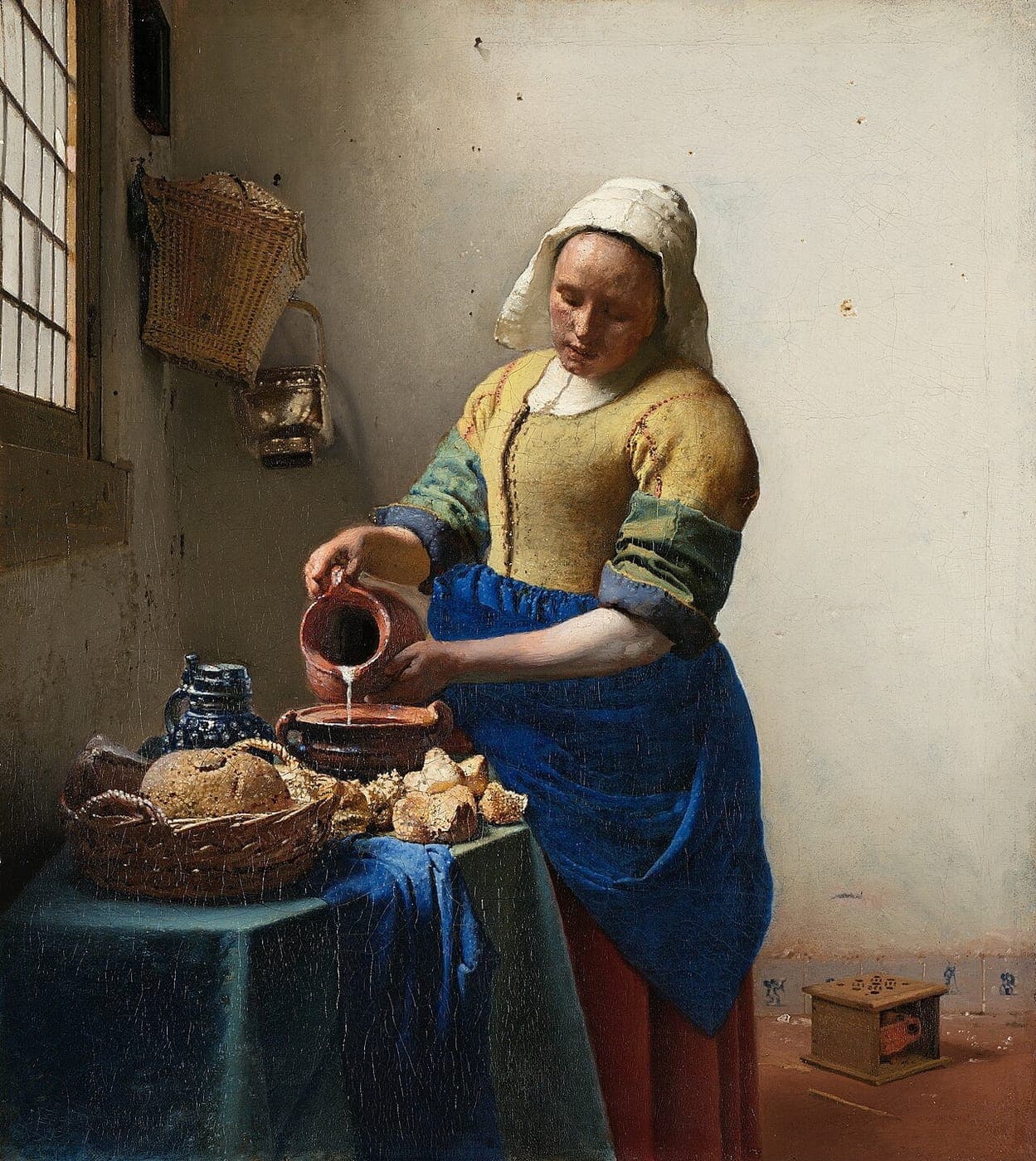
A young kitchen maid pours milk into a bowl beside a window, her attention entirely on the thin white stream. Painted around 1658–1660, Vermeer's The Milkmaid is one of the most loved paintings in the Netherlands.
In this article
A simple scene
In a corner of a whitewashed room, a sturdy young woman stands at a table by the window, pouring milk from an earthenware jug into a bowl. On the table lie bread, a basket and a blue cloth. She works slowly and carefully, her eyes lowered. Johannes Vermeer painted the scene in Delft around 1658–1660, and it has been called the most perfect picture of quiet concentration in Western art.
Maids were a common subject in Dutch painting, often shown as flirtatious or lazy, with hidden moral messages. Vermeer's milkmaid is different. She is dignified, absorbed in her work, almost monumental. The painting celebrates the virtues of domestic labour and the beauty of ordinary things.
The stream of milk
At the centre of the painting, a thin stream of milk flows from the jug into the bowl. It is the only movement in a perfectly still room, and it makes time seem to slow down. Vermeer painted it with a few strokes of white over grey, so delicately that the milk seems to be moving as you watch.
 Detail 1

The stream of milk
A thin trickle of white flows from the jug. It is the only moving thing in the painting, and it gives the scene its sense of suspended time.
The bread and the points of light
On the table, the bread and the basket sparkle with tiny dots of light-coloured paint. Vermeer used this technique, known as pointillé, to show how light catches rough surfaces. The bread crust glows with dots of yellow and white, as if lit from within.
Detail 2Glittering bread
Tiny dots of light paint make the crust of the bread sparkle. Vermeer may have studied such effects with a camera obscura, which turns highlights into small circles of light.
Precious blue and yellow
The maid wears a yellow bodice and a blue apron and sleeves. The blue is natural ultramarine, the most expensive pigment of the time, made from lapis lazuli. Vermeer used it generously, even mixing it into the shadows of the white wall. The combination of yellow and blue, his favourite colours, gives the figure its glow.
Detail 3Face and white cap
The maid's face is lowered in concentration, framed by a white linen cap. The light from the window models her cheek and forehead softly.
The details on the wall and floor
The wall behind her, which looks empty, is full of details: nail holes, a nail with its shadow, cracks in the plaster. On the floor at the right stands a foot warmer, a wooden box holding a pot of hot coals, and beside it a row of Delft tiles decorated with Cupid, which may hint at the maid's thoughts of love.
Detail 4The foot warmer and tiles
A foot warmer stands on the floor beside tiles decorated with Cupid and a traveller, small symbols that may suggest love and longing.
Hidden changes
Research by the Rijksmuseum in 2019 revealed that Vermeer originally painted a jug rack on the wall behind the maid and a laundry basket on the floor, which he later painted out. He simplified the composition to concentrate all attention on the woman and her task.
Seeing The Milkmaid
The painting is small, about 45.5 by 41 centimetres, and hangs in the Gallery of Honour of the Rijksmuseum in Amsterdam, close to Rembrandt's The Night Watch.
Own a hand-painted copy
The Milkmaid
Painted by hand in oil on canvas, any size. Free worldwide shipping.
From $349 — Make it yours.Frequently asked questions
What is The Milkmaid doing?
She is pouring milk from a jug into a bowl, probably to make bread pudding with the stale bread on the table.
When was The Milkmaid painted?
Vermeer painted it around 1658–1660 in Delft.
What is the box on the floor in The Milkmaid?
It is a foot warmer, a wooden box with a pot of hot coals inside, used to keep feet warm.
Where is The Milkmaid?
It is in the Rijksmuseum in Amsterdam.
Sources and further reading
- Rijksmuseum, collection notes on The Milkmaid
- Rijksmuseum, technical research on The Milkmaid (2019)
- Walter Liedtke, Vermeer: The Complete Paintings (2008)
