Listen to this article
0:00 / 3:12 · Read by ArtLogia
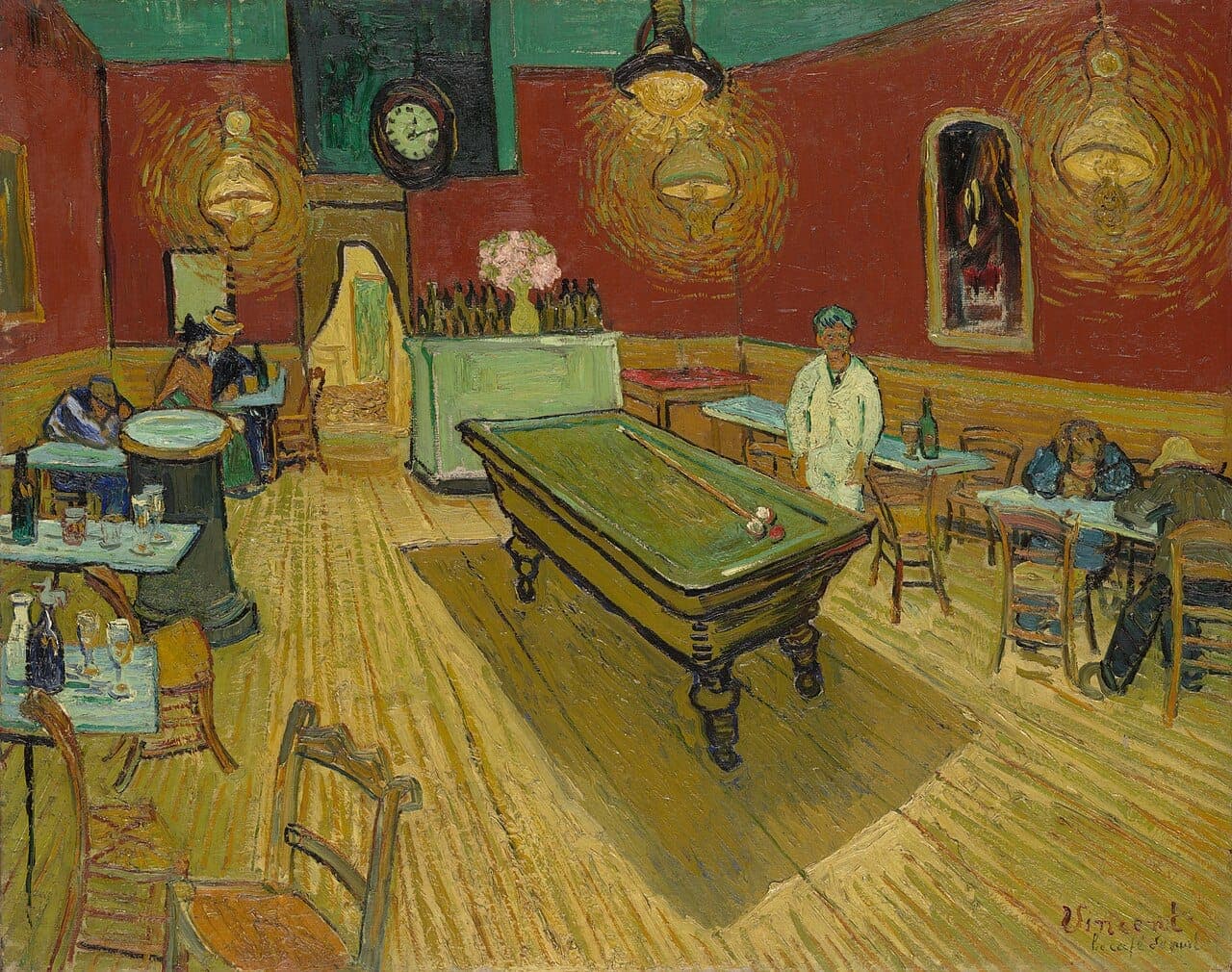
Gas lamps blaze over a billiard table in an all-night café in Arles, where a few lonely customers slump at their tables and the landlord stands in white. Van Gogh painted The Night Café in September 1888 and called it one of the ugliest pictures he had made, and one of the most expressive.
In this article
Three nights awake
In September 1888 Vincent van Gogh was living in Arles, in the south of France, and took his meals at the Café de la Gare, run by Joseph and Marie Ginoux. The café stayed open all night, and night wanderers without money for a room could sleep there. Van Gogh stayed up three nights in a row to paint it, sleeping during the day.
He wrote to his brother Theo that he had tried "to express the terrible passions of humanity by means of red and green", and that the café was "a place where one can ruin oneself, go mad or commit a crime".
The clash of red and green
The walls are blood red, the ceiling green, the floor yellow. Red and green are complementary colours: placed side by side, they intensify each other and create a vibrating, uncomfortable effect. Van Gogh used this clash deliberately to make the viewer feel the oppressive, feverish atmosphere of the room.
 Detail 1

Red walls and the clock
The clock on the red wall shows a quarter past midnight. The violent red and green of walls and ceiling create the room's feverish atmosphere.
The haloed lamps
Four gas lamps hang from the ceiling, each surrounded by rings of yellow and orange light, like small suns. The glare seems to vibrate and fill the room with a harsh, sleepless light. The same halos would reappear in Van Gogh's starry skies.
Detail 2Lamps with halos
The gas lamps blaze in concentric rings of yellow and orange. Their glare fills the room with a sleepless, unforgiving light.
The billiard table
In the centre stands a green billiard table, casting a long shadow on the yellow floor. The steep perspective, with the floor rising sharply towards the back, makes the room seem to tilt and pulls the viewer in. Cues and balls lie on the table, abandoned.
Detail 3The billiard table
The empty billiard table casts a dark shadow across the floor. The tilting perspective makes the room feel unstable.
The landlord and the night customers
Beside the billiard table stands the landlord, Joseph Ginoux, dressed in white, looking out at the viewer. Around the edges of the room, a few customers sit alone or slump over their tables, asleep or drunk, while a couple sits close together in the back corner. They are anonymous, lonely figures, lost in the night.
Detail 4The landlord in white
Joseph Ginoux stands in a pale coat beside the table, looking out at us. He is the only figure who seems fully awake.
Detail 5Sleepers at the tables
On the left, night wanderers sit slumped at their tables. They are the people who could not afford a room and spent the night in the café.
From Arles to Yale
The painting later belonged to the Russian collector Ivan Morozov, and after the Russian Revolution it was sold by the Soviet state. It was bought by the American collector Stephen Carlton Clark, who left it to Yale University in 1961. The painting measures about 72 by 92 centimetres and is in the Yale University Art Gallery in New Haven.
Own a hand-painted copy
The Night Café
Painted by hand in oil on canvas, any size. Free worldwide shipping.
From $299 — Make it yours.Frequently asked questions
Where is the café in The Night Café?
It is the Café de la Gare in Arles, in the south of France, run by Joseph and Marie Ginoux.
Why did Van Gogh use red and green?
He used the clash of complementary red and green to express the "terrible passions of humanity" and the oppressive atmosphere of the café.
What time is it in The Night Café?
The clock on the wall shows about a quarter past midnight.
Where is The Night Café?
It is in the Yale University Art Gallery in New Haven, Connecticut.
Sources and further reading
- Yale University Art Gallery, collection notes on The Night Café
- Vincent van Gogh, letter to Theo van Gogh, 8 September 1888
- Van Gogh Museum letters edition
