

Listen to this article
0:00 / 3:45 · Read by ArtLogia
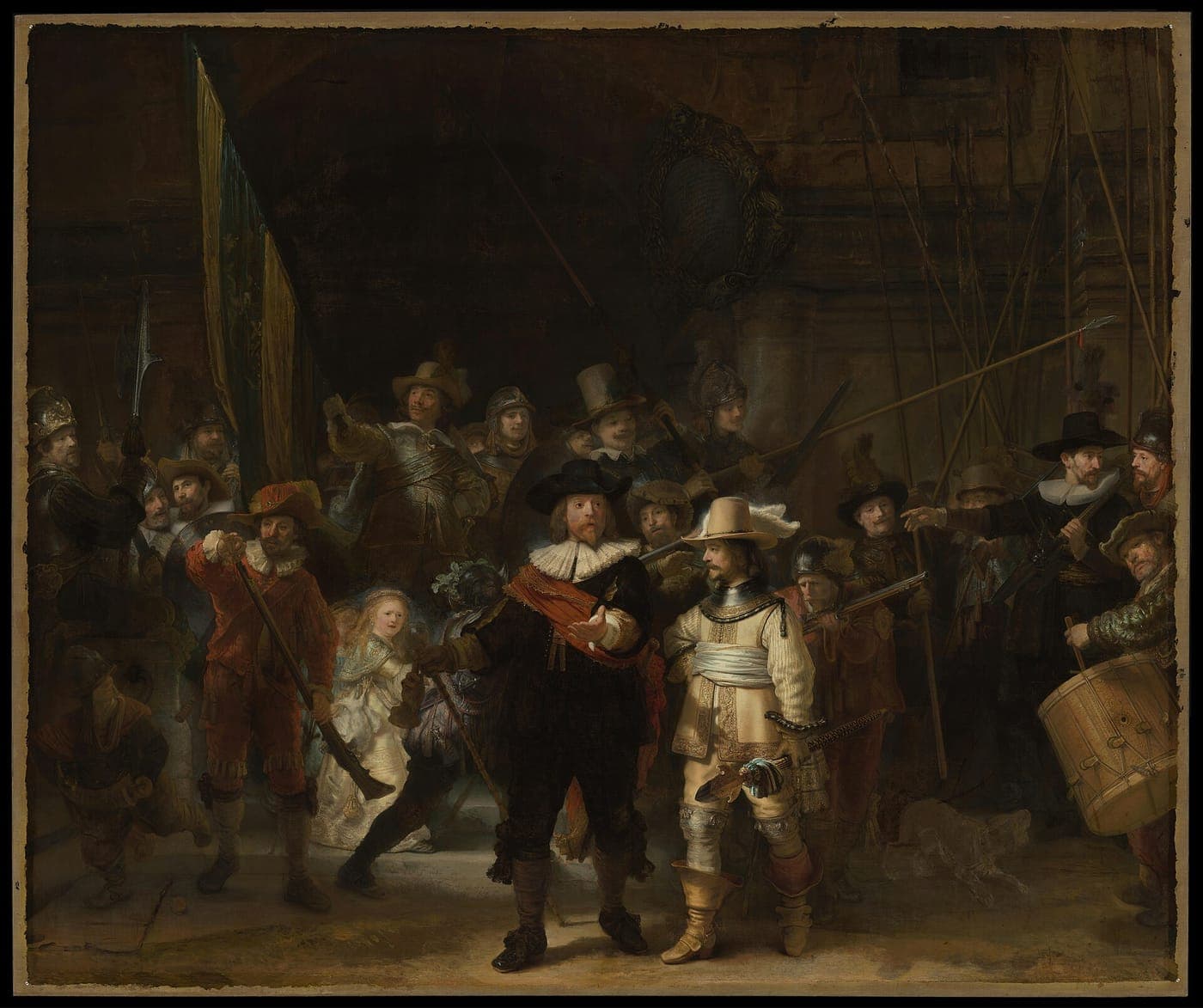
The Night Watch is not set at night, and it is not a watch. It is a group portrait of an Amsterdam civic militia company that Rembrandt turned into a scene of drama, light and movement, unlike any group portrait before it.
In this article
A group portrait unlike any other
In 1642 the civic militia company of District II in Amsterdam, led by Captain Frans Banninck Cocq, received its group portrait from Rembrandt van Rijn. It was to hang in the great hall of the Kloveniersdoelen, the headquarters of the musketeers, alongside portraits of other companies. Each member who appeared in it contributed to the fee according to his place in the picture.
Group portraits of militias usually showed the men in neat rows, eating or posing. Rembrandt did something radical: he showed the company in action, setting off at the captain's command, with men loading guns, raising pikes, beating a drum and shouting. The painting is officially called Militia Company of District II under the Command of Captain Frans Banninck Cocq.
Why "The Night Watch"?
The nickname dates from the late eighteenth century, when the varnish had darkened so much that the scene seemed to take place at night. In fact it is daylight. Cleaning in the twentieth century revealed brighter colours, though the dramatic contrast of light and shadow remains Rembrandt's own.
The captain and his lieutenant
In the centre stride the two officers. Captain Banninck Cocq, dressed in black with a red sash, stretches out his hand as he gives the order to march. Beside him, Lieutenant Willem van Ruytenburch shines in yellow-gold, his partisan catching the light. The shadow of the captain's hand falls on the lieutenant's coat, a brilliant touch that shows they stand close together in space.
 Detail 1

The captain's command
Banninck Cocq's outstretched hand and red sash mark him as the leader. His hand casts a shadow on the lieutenant's golden coat.
Detail 2The lieutenant in gold
Willem van Ruytenburch wears a yellow buff coat embroidered with the arms of Amsterdam. His bright figure balances the dark captain beside him.
The girl with the chicken
In the left middle ground, a girl in a golden dress seems lit by a spotlight. At her belt hangs a dead chicken with prominent claws. The claws were the emblem of the Kloveniers, the arquebusiers, so she is a kind of living mascot of the company, a symbol rather than a real member.
Detail 3The mysterious girl
The glowing girl carries a dead bird whose claws are the symbol of the militia. She is one of the most discussed figures in Dutch art.
Hidden details
Look above the heads in the centre and you may see an eye and a beret peeping out between two men: some believe Rembrandt painted himself into the crowd. On the right a drummer beats his drum, and a dog barks at the sound. Above the arch hangs a shield with the names of the members who paid for the painting, added after it was finished.
Detail 4The drummer
The drummer on the right beats the march while a dog barks beside him. Sound and noise are part of the scene, a novelty in group portraits.
A painting cut down
In 1715 the painting was moved to Amsterdam's Town Hall, where it did not fit between two doors. It was trimmed on all sides, especially on the left, where two figures were lost. A seventeenth-century copy by Gerrit Lundens, now in the National Gallery in London, shows the original composition. In 2021 the Rijksmuseum used artificial intelligence and the copy to recreate the missing strips temporarily.
The painting today
The Night Watch is about 3.6 by 4.4 metres, Rembrandt's largest surviving painting. It hangs at the end of the Gallery of Honour in the Rijksmuseum in Amsterdam, where Operation Night Watch, the largest research and restoration project in its history, has been carried out in full view of visitors.
Own a hand-painted copy
The Night Watch
Painted by hand in oil on canvas, any size. Free worldwide shipping.
From $299 — Make it yours.Frequently asked questions
Why is it called The Night Watch?
The name dates from the late 18th century, when the darkened varnish made the daylight scene look like night. The painting actually shows a militia company setting out by day.
Who is the girl in The Night Watch?
She is not a real member of the militia but a symbolic figure: the dead chicken at her belt shows claws, the emblem of the Kloveniers company.
Was The Night Watch cut?
Yes. In 1715 it was trimmed on all sides to fit a wall in Amsterdam's Town Hall; a copy by Gerrit Lundens shows the original composition.
Where is The Night Watch?
It is in the Rijksmuseum in Amsterdam, in the Gallery of Honour.
Sources and further reading
- Rijksmuseum, collection notes on The Night Watch
- Rijksmuseum, Operation Night Watch research project
- Gary Schwartz, Rembrandt's Universe (2006)
