


Listen to this article
0:00 / 3:21 · Read by ArtLogia
Three brothers raise their arms to swear an oath on swords held by their father, while the women of the family collapse in grief. Shown in Paris in 1785, Jacques-Louis David's The Oath of the Horatii became the manifesto of Neoclassical painting.
In this article
A story from early Rome
The Roman historian Livy told how, in the seventh century BC, Rome and the neighbouring city of Alba Longa decided to settle their war by a combat between champions. Rome chose the three Horatii brothers, Alba the three Curiatii brothers. But the families were bound by marriage: one of the Horatii sisters, Camilla, was engaged to one of the Curiatii, and a Curiatii sister, Sabina, was married to one of the Horatii.
Jacques-Louis David chose a moment that is not in Livy: the three brothers swearing to their father that they will win or die for Rome. He painted it in Rome itself in 1784, commissioned by the royal administration of Louis XVI, and showed it at the Paris Salon of 1785, where it was a triumph.
The oath
On the left, the three brothers stand in a single block, their bodies leaning forward, their right arms stretched towards the swords their father holds up. Their legs are planted firmly like the columns behind them. The repetition of the arms and legs creates a powerful rhythm of determination and unity.
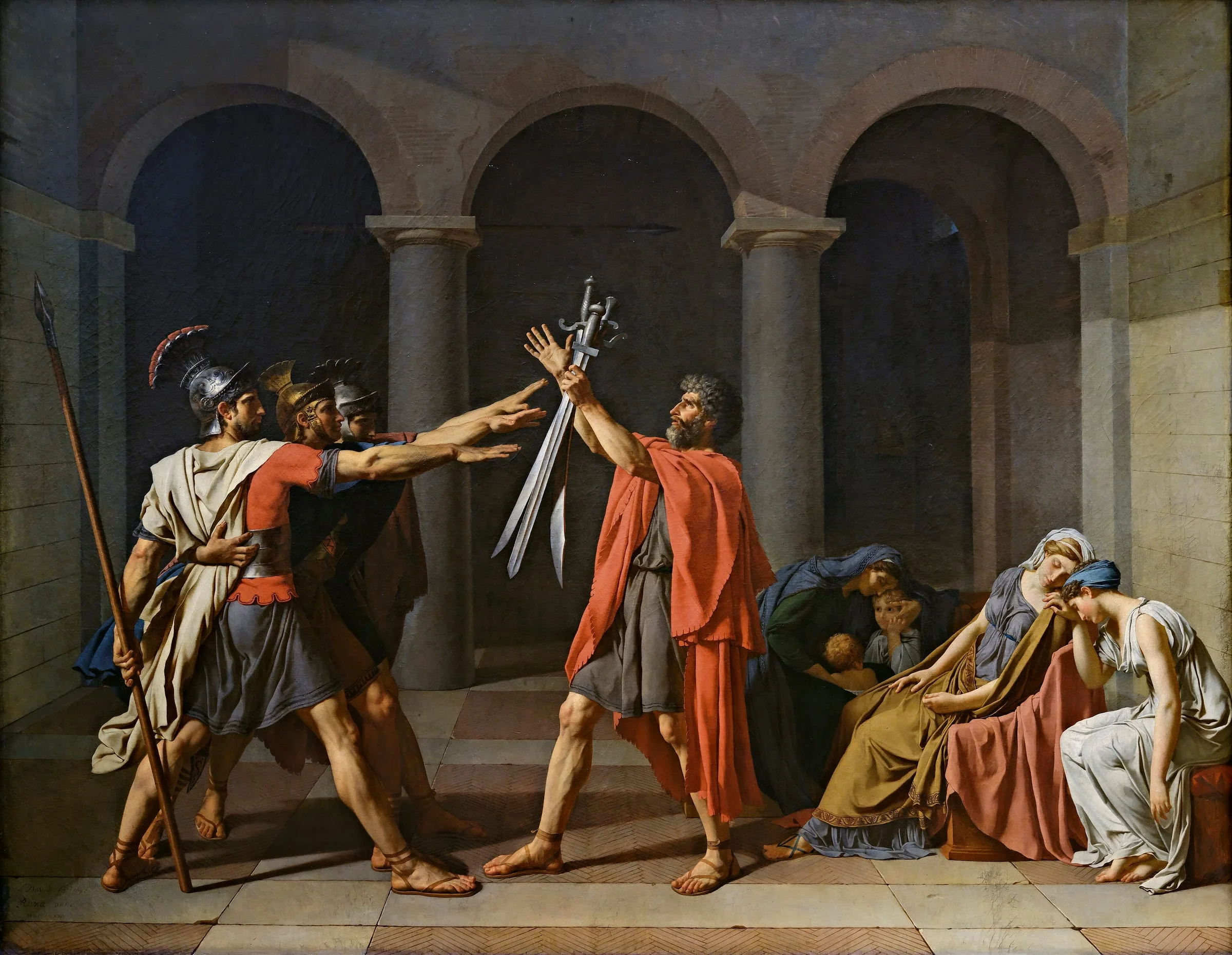 Detail 1
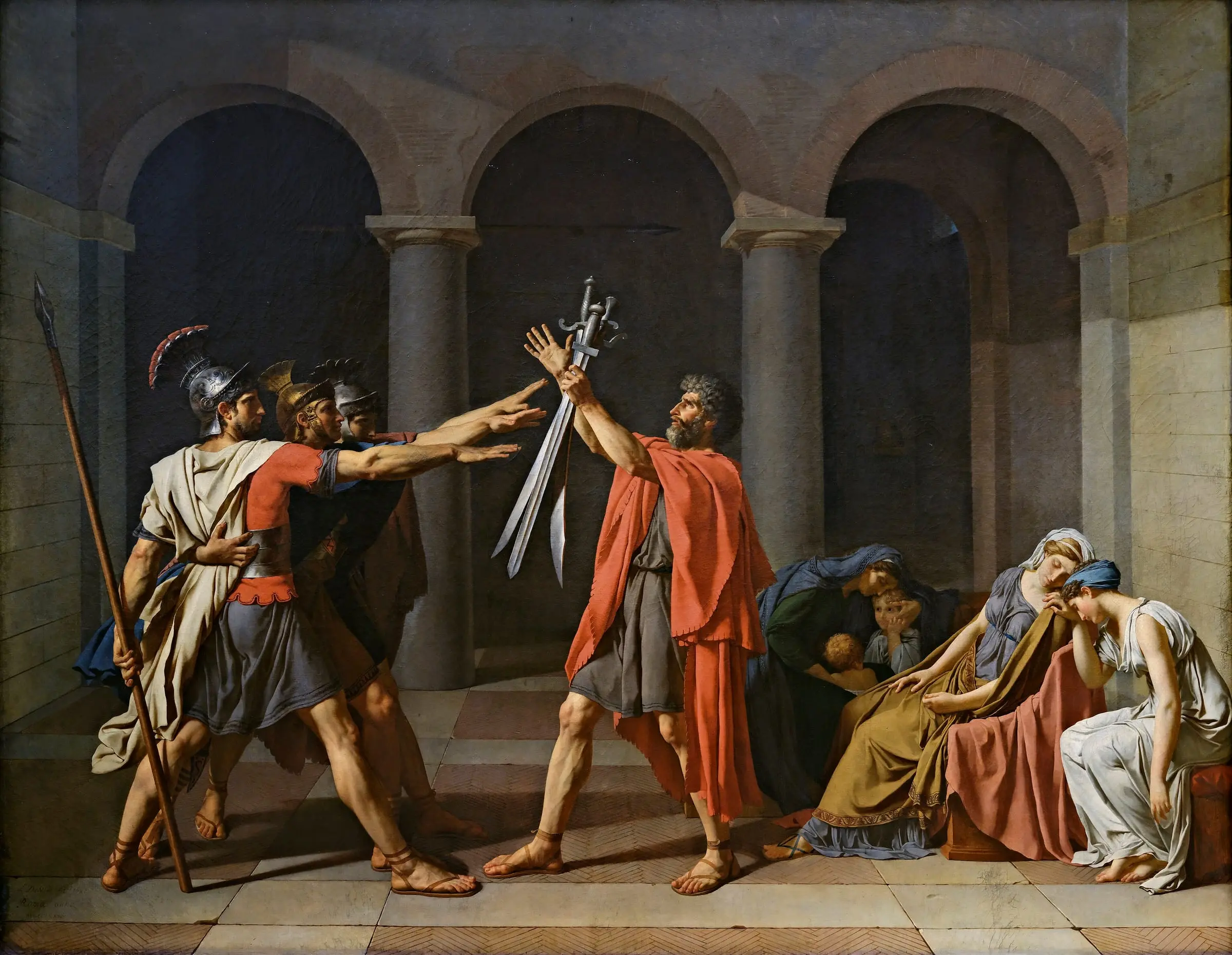
Three arms raised
The brothers' outstretched arms, one behind the other, form a single gesture of commitment. Their tense bodies express total devotion to the state.
The father and the swords
In the centre, the father, the elder Horatius, holds up three swords, gleaming against the dark arch behind him. His eyes are raised to heaven as he asks the gods to witness the oath. The swords are the exact centre of the composition, where the lines of the brothers' arms converge.
Detail 2The three swords
The swords held by the father are the focal point of the painting. The brothers' oath and the father's prayer meet in the gleaming blades.
The grieving women
On the right, in complete contrast, the women of the family sit huddled together in sorrow: Camilla, who will lose her fiancé, and Sabina, who will lose either a brother or her husband, with the children. Their soft, curving forms and drooping heads are the opposite of the men's straight, tense lines.
Detail 3The women's grief
Sabina and Camilla lean on each other, their eyes closed in grief. Their curving forms contrast with the rigid lines of the men.
The architecture
The scene takes place in a simple Roman courtyard with three arches resting on Doric columns. Each arch frames one group: the brothers, the father, the women. This severe, clear structure was revolutionary at a time when French painting was dominated by the playful, decorative Rococo style.
Detail 4Three arches
The three arches divide the scene into three groups, like the panels of a frieze. The bare architecture concentrates attention on the action.
A painting that announced a revolution
The Oath of the Horatii exalted patriotism, sacrifice and civic virtue over personal feelings. Four years later the French Revolution broke out, and David became its leading painter. Looking back, many saw in the painting a foreshadowing of the revolutionary ideal of sacrifice for the nation.
Seeing The Oath of the Horatii
The painting is about 3.3 by 4.25 metres. It hangs in the Musée du Louvre in Paris, in the galleries of large French paintings, near David's Coronation of Napoleon.
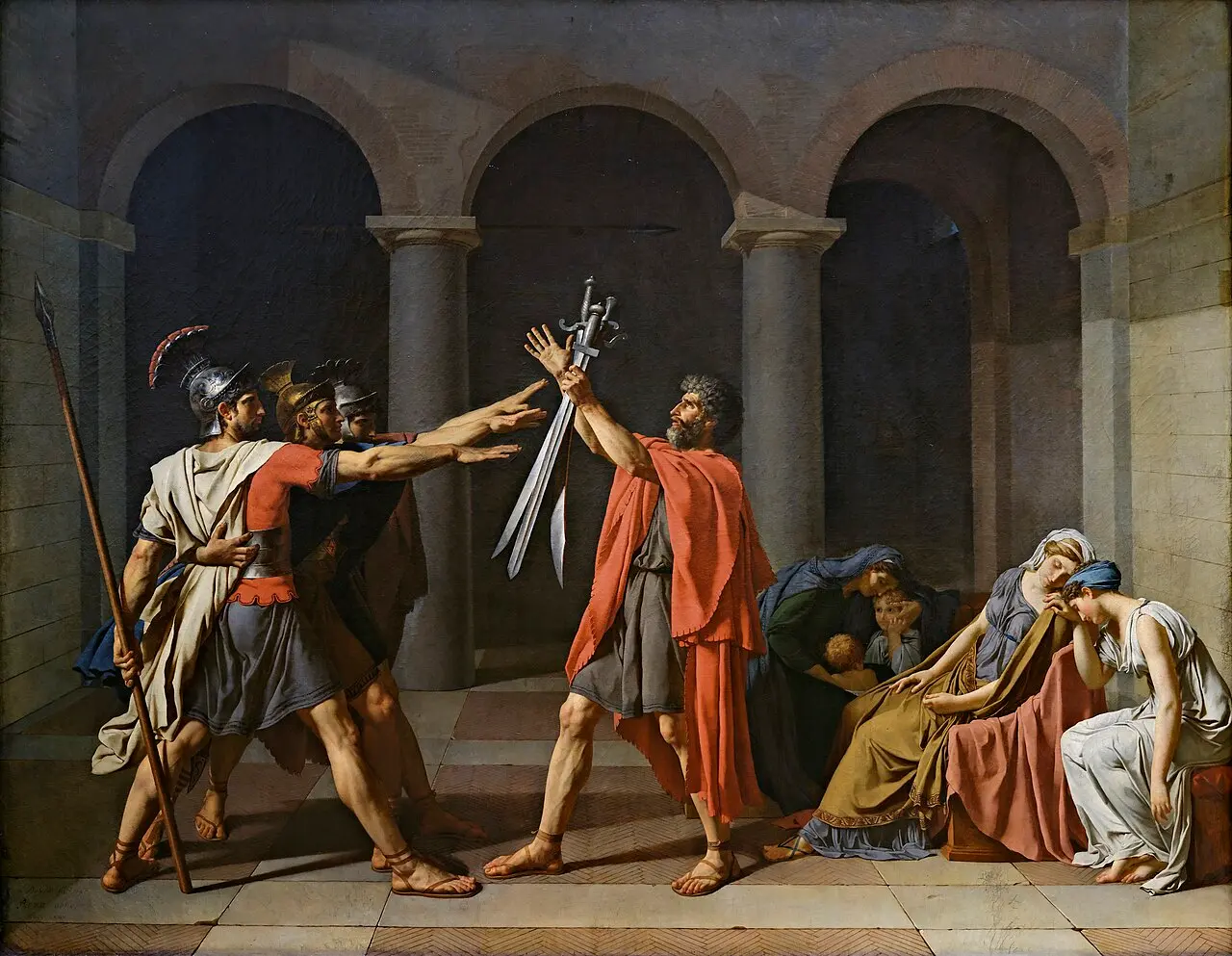
Own a hand-painted copy
The Oath of the Horatii
Painted by hand in oil on canvas, any size. Free worldwide shipping.
From $299 — Make it yours.Frequently asked questions
What is the story of the Oath of the Horatii?
It shows three Roman brothers swearing to fight to the death for Rome against three champions of Alba Longa, according to a legend told by Livy.
Who painted The Oath of the Horatii?
The French Neoclassical painter Jacques-Louis David painted it in 1784.
Why are the women sad?
The families were linked by marriage, so whatever the outcome, the women would lose a brother, a husband or a fiancé.
Where is The Oath of the Horatii?
It is in the Musée du Louvre in Paris.
Sources and further reading
- Musée du Louvre, collection notes on The Oath of the Horatii
- Thomas Crow, Painters and Public Life in Eighteenth-Century Paris (1985)
- Livy, History of Rome, Book I
