Listen to this article
0:00 / 3:35 · Read by ArtLogia
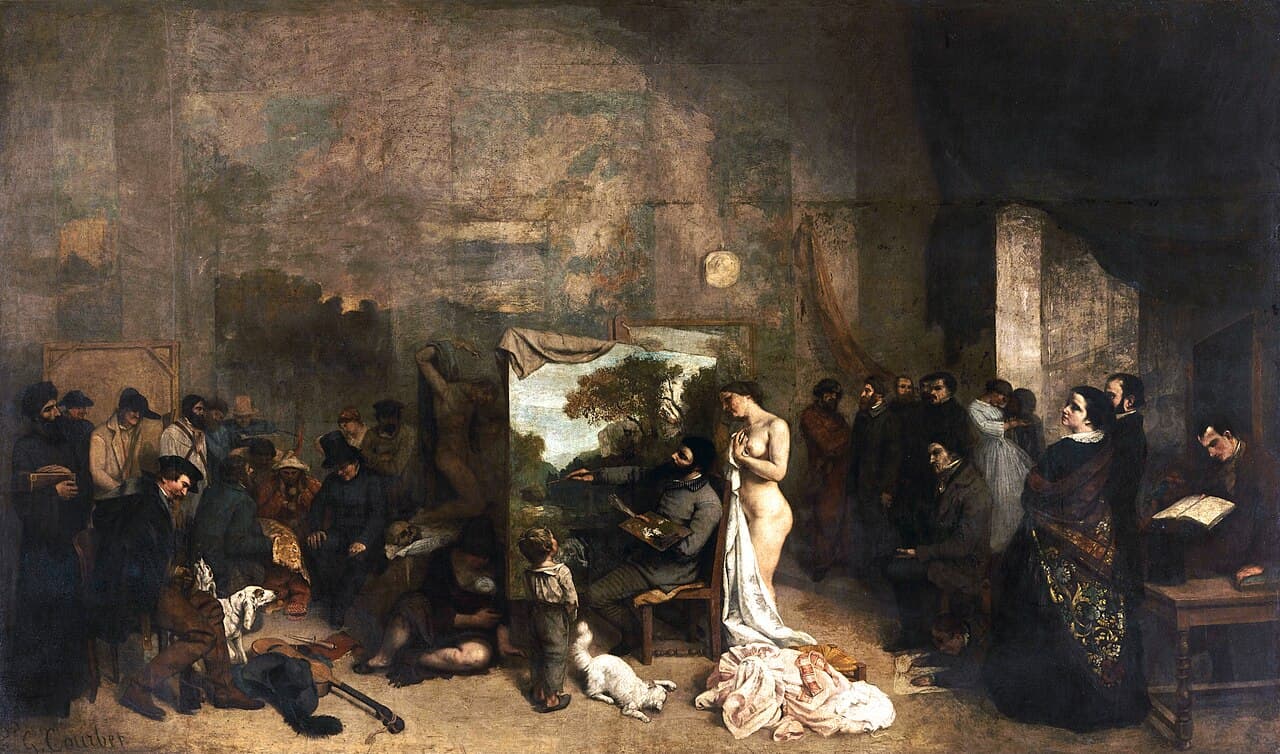
At the centre of a vast studio, Courbet paints a landscape, watched by a nude model and a small boy, between a crowd of ordinary people on the left and his friends and supporters on the right. Painted in 1855, The Painter's Studio is a manifesto of Realism and a portrait of French society.
In this article
A real allegory
In 1855 Paris hosted a Universal Exhibition. The jury accepted eleven of Gustave Courbet's paintings but rejected his two largest, including this one. Courbet responded by building his own pavilion near the exhibition, the Pavilion of Realism, where he showed forty of his works, an act of independence that later artists would follow.
He gave the painting a long subtitle: A real allegory summing up seven years of my artistic and moral life. In a letter to the critic Champfleury, he explained that it showed the whole world coming to him to be painted: on the right, his friends, the workers and lovers of art; on the left, the other world of everyday life, the people, the poor, the rich, the exploited and the exploiters.
The painter at his easel
At the centre, Courbet sits at his easel, painting a landscape of his native Franche-Comté. He is surrounded by the tools of his art and a large canvas. Rather than painting the nude model behind him, he paints nature: a statement that Realism finds its subject in the real world.
 Detail 1

Courbet at his easel
The painter sits before a landscape of his homeland, brush in hand, at the centre of his own world.
The boy and the cat
Beside the easel, a small peasant boy watches the painter with admiration, perhaps a symbol of innocent, unspoilt vision. At Courbet's feet, a white cat plays on the floor.
Detail 2The admiring boy
A barefoot boy watches the painter at work, an image of the innocent eye that Courbet wanted to address.
Detail 3The white cat
A white cat plays at the painter's feet, a lively, ordinary detail at the centre of the allegory.
The two worlds
On the left, in shadow, are figures from all levels of society: a rabbi, a priest, a hunter, a merchant, a labourer, a beggar woman with her child. Some historians see hidden portraits of political figures among them, including Napoleon III as the hunter.
Detail 4The world of everyday life
On the left, figures representing society, from the poor to the powerful, wait in the shadows of the studio.
On the right are Courbet's friends and supporters: the collector Alfred Bruyas, the philosopher Proudhon, the critic Champfleury, an elegant couple of art lovers, and, on the far right, the poet Charles Baudelaire reading a book.
Detail 5Baudelaire reading
On the far right, the poet Charles Baudelaire sits absorbed in a book, one of the friends who supported Courbet's art.
A painting of ideas
The Painter's Studio is full of allusions to the politics and culture of the 1850s. Courbet was a republican and a friend of the socialist philosopher Pierre-Joseph Proudhon, and he saw his art as a way of showing the truth of society. The crowd on the left includes figures that some historians read as references to Napoleon III's regime and to the exploitation of the poor; the group on the right represents art, friendship, love and freedom. In the centre, the painter, the model and the child form a kind of trinity of Realism: nature, truth and innocent vision. The painting is both a self-portrait and a declaration of what art should be, and it remains one of the most debated works of the nineteenth century.
Seeing The Painter's Studio
The painting is immense, about 3.6 by 6 metres. It was bought by the Louvre in 1920 and now hangs in the Musée d'Orsay in Paris, near A Burial at Ornans.
Own a hand-painted copy
The Painter's Studio
Painted by hand in oil on canvas, any size. Free worldwide shipping.
From $349 — Make it yours.Frequently asked questions
What does The Painter's Studio represent?
Courbet called it a "real allegory" of seven years of his artistic and moral life, showing society on the left and his friends on the right.
Who is reading on the right of The Painter's Studio?
The man reading on the far right is the poet Charles Baudelaire.
Why did Courbet build his own pavilion in 1855?
The Universal Exhibition rejected The Painter's Studio, so he exhibited it in his own Pavilion of Realism.
Where is The Painter's Studio?
It is in the Musée d'Orsay in Paris.
Sources and further reading
- Musée d'Orsay, collection notes on The Painter's Studio
- Gustave Courbet, letter to Champfleury, 1854
- Hélène Toussaint, catalogue of the Courbet exhibition (Grand Palais, 1977)
