Listen to this article
0:00 / 3:20 · Read by ArtLogia
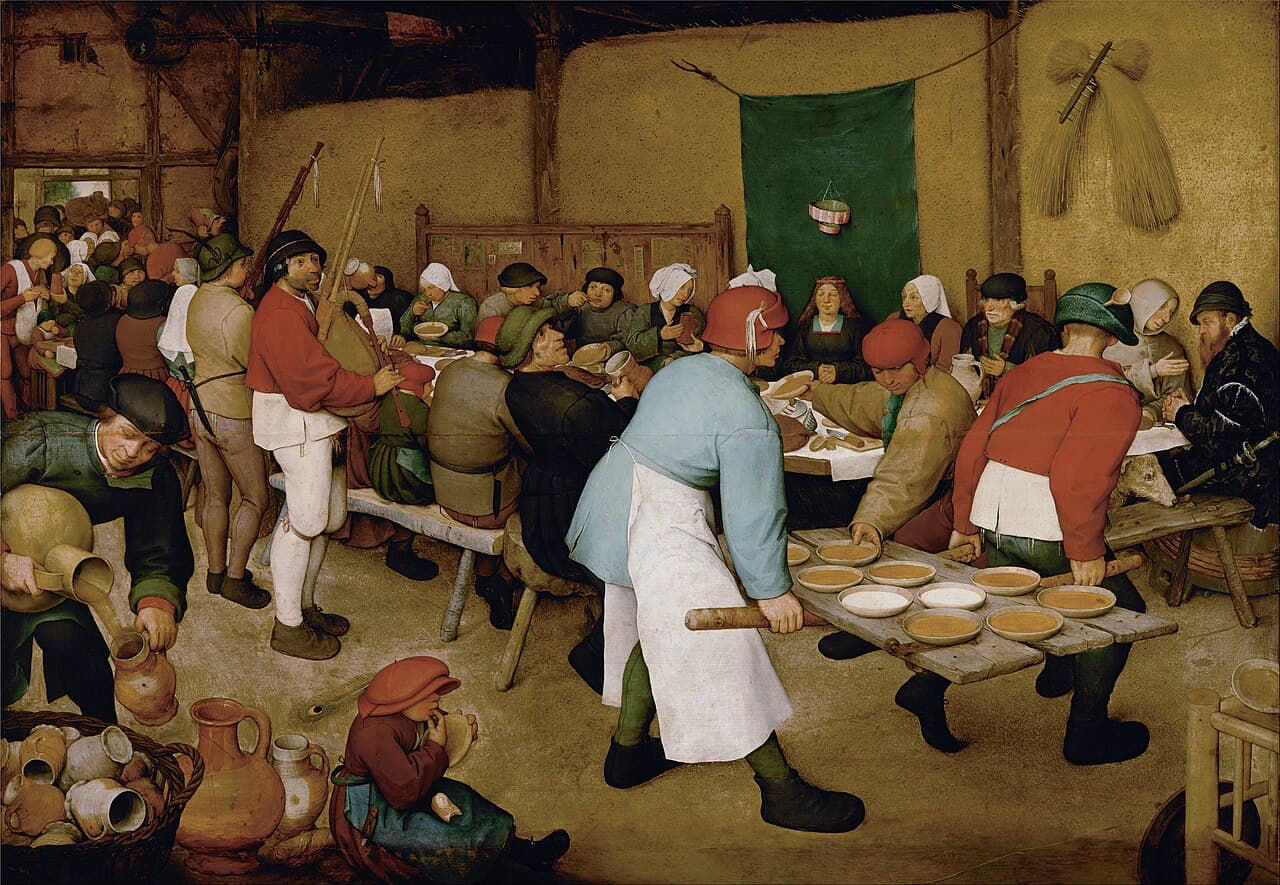
In a barn decorated with sheaves of wheat, a village wedding feast is in full swing: men carry plates of porridge on a door, bagpipers play, a child licks a bowl, and the bride sits calmly under a green cloth. Painted around 1567, Bruegel's The Peasant Wedding is one of the liveliest images of village life ever painted.
In this article
A feast in a barn
Pieter Bruegel the Elder, often nicknamed "Peasant Bruegel", painted many scenes of rural life. According to his early biographer Karel van Mander, he and a friend used to dress as peasants to attend village weddings and fairs, so that they could observe the people closely.
The Peasant Wedding, painted around 1567, shows a wedding feast inside a barn, its walls hung with sheaves of grain from the harvest. More than twenty guests sit at a long table or crowd around it, eating, drinking and talking.
The bride
The bride sits in the centre of the back wall, in front of a green cloth hung from the wall, with a paper crown above her head. She sits with her hands folded, her eyes half closed, a calm smile on her face. By custom, the bride did not eat or speak during the feast.
 Detail 1

The bride under the green cloth
The bride sits calmly in front of a green cloth, a paper crown hanging above her, the only motionless figure in the crowd.
Where is the groom?
The identity of the groom is one of the painting's puzzles. He may be the young man in the foreground pouring beer, the man seated near the bride, or he may be absent, as some customs required the groom to serve the guests or stay away. Viewers have debated it for centuries.
Food on a door
In the foreground, two men carry bowls of porridge or custard on a door taken off its hinges, serving the guests. One of them, in a red jacket, has a spoon tucked into his hat. A guest passes the bowls along the table.
Detail 2Serving on a door
Two men carry bowls of porridge on a door used as a tray, one with a spoon tucked in his hat.
The bagpipers
On the left, two bagpipers play for the guests, one staring hungrily at the passing food. Music was an essential part of the feast.
Detail 3The bagpiper's hungry look
A bagpiper stops to look longingly at the food carried past him, his music forgotten for a moment.
The child licking the bowl
In the lower left corner, a small child in a large red hat sits on the floor, licking a bowl clean with its fingers. It is one of the most charming details in the painting.
Detail 4A child licks the bowl
In the corner, a small child in a huge hat licks the bowl clean, absorbed in the meal.
Detail 5Pouring the beer
On the left, a man pours beer from a large jug into smaller jugs, keeping the guests supplied.
Two important guests
On the far right, a monk and a man in black, perhaps the landlord or a notable of the village, talk at the end of the table, a little apart from the peasants. Their presence shows the different social classes present at village festivities.
Detail 6The friar and the notable
At the end of the table, a friar talks with a man in fine black clothes, guests of a higher rank.
Seeing The Peasant Wedding
The painting measures about 1.14 by 1.64 metres and hangs in the Kunsthistorisches Museum in Vienna, alongside The Hunters in the Snow and the Tower of Babel.
Own a hand-painted copy
The Peasant Wedding
Painted by hand in oil on canvas, any size. Free worldwide shipping.
From $299 — Make it yours.Frequently asked questions
Where is the bride in The Peasant Wedding?
She sits in the centre in front of a green cloth, with a paper crown above her head.
Who is the groom in The Peasant Wedding?
His identity is uncertain; he may be the man pouring beer, a man near the bride, or absent according to local custom.
When was The Peasant Wedding painted?
Pieter Bruegel the Elder painted it around 1567.
Where is The Peasant Wedding?
It is in the Kunsthistorisches Museum in Vienna.
Sources and further reading
- Kunsthistorisches Museum Vienna, collection notes on The Peasant Wedding
- Manfred Sellink, Bruegel: The Complete Paintings, Drawings and Prints (2007)
- Svetlana Alpers, "Bruegel's Festive Peasants", Simiolus (1973)
