Listen to this article
0:00 / 3:08 · Read by ArtLogia
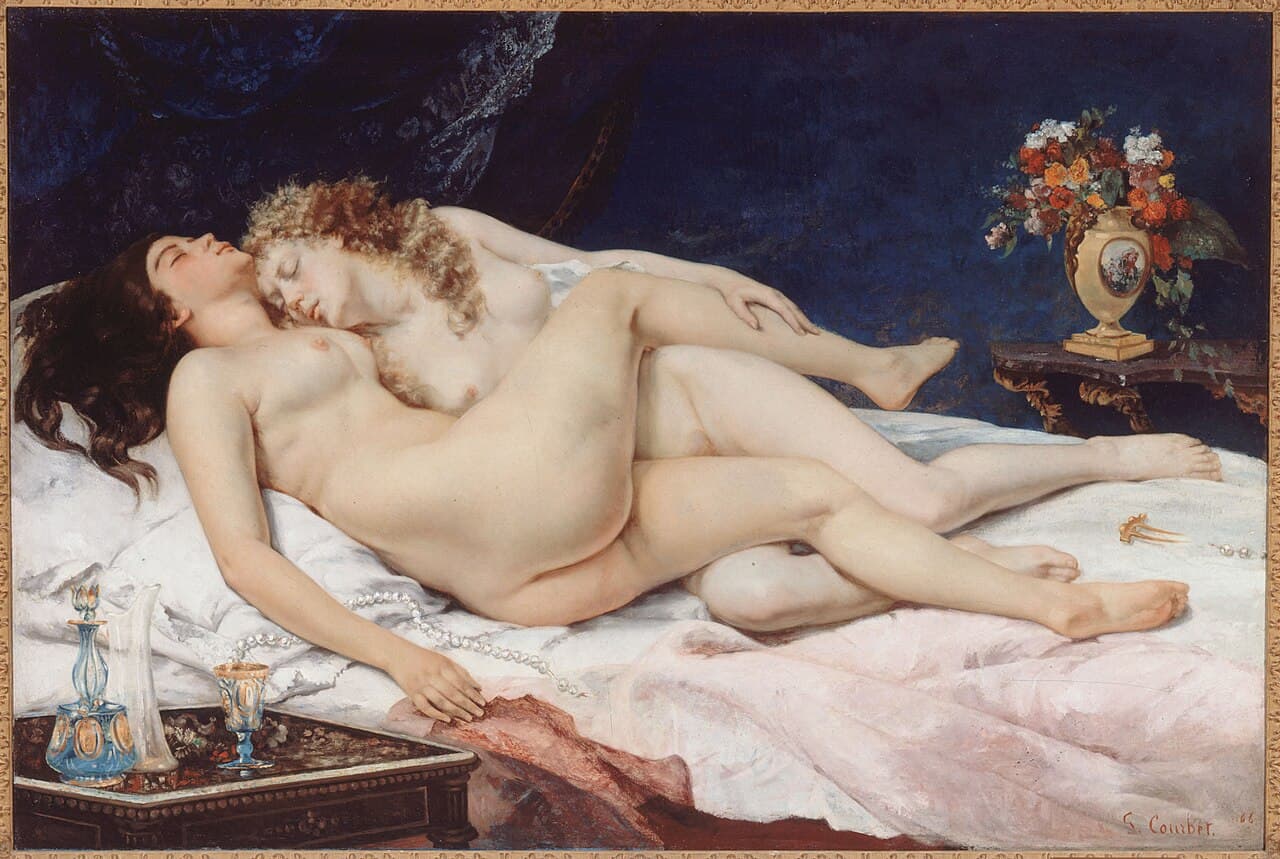
Two women sleep entwined on a bed among scattered pearls, a vase of flowers and a crystal glass. Painted by Gustave Courbet in 1866 for the collector Khalil-Bey, The Sleepers was so controversial that it was kept from public view for decades.
In this article
A private commission
In 1866 Gustave Courbet painted The Sleepers, also called Le Sommeil (Sleep), for Khalil-Bey, the Ottoman diplomat and collector in Paris who also commissioned L'Origine du monde. The painting shows two women asleep on a bed, their bodies entwined. Like L'Origine du monde, it was meant for a private collection and could not have been shown at the official Salon.
The subject recalls the poems of Charles Baudelaire, a friend of Courbet, and the theme of the nude in the work of artists from Titian to Ingres, but Courbet treated it with the frank, unidealised realism that defined his art.
Realism and the nude
Courbet painted the two figures with warm, solid flesh tones, one fair-haired and one dark-haired, against the white sheets and dark blue background. The painting is less about narrative than about the beauty of the bodies, the textures of skin, hair and fabric, and the stillness of sleep.
The still life
Around the bed, Courbet painted a luxurious still life. A crystal carafe and a glass stand on a small table at the lower left, and a vase of flowers rests on a side table in the background. A broken pearl necklace and a hair comb lie scattered on the bed, suggesting the passing of the night.
 Detail 1

The vase of flowers
A porcelain vase of flowers stands in the background, painted with the richness of a Dutch still life.
Detail 2Crystal carafe and glass
A cut-glass carafe and a small glass stand on the table at the front, catching the light with sparkling reflections.
A hidden painting
After Khalil-Bey's ruin in 1868, the painting passed through private collections and was long considered too scandalous to be exhibited publicly. It was bought by the City of Paris in 1953 for the Petit Palais, where it hangs today among the museum's collection of nineteenth-century French painting.
Courbet's place in art
The Sleepers shows Courbet's skill as a painter of the nude and of still life, and his refusal to hide behind mythological pretexts. It influenced later artists, from the Impressionists to modern painters, in their frank approach to the human body. Because of the nature of the subject, this guide includes only details of the still life.
The painting measures about 1.35 by 2 metres.
Courbet and the nude
Courbet painted many nudes in the 1860s, and they were among his most commercially successful works, bought by private collectors who appreciated their realism and sensuality. He approached the female body as he approached landscapes and animals: with careful observation of texture, weight and light, without the idealisation of the academic nude. In The Sleepers, the richness of the setting, the deep blue background, the white sheets, the porcelain vase and the crystal glass, shows his skill as a still-life painter as much as a painter of figures. The painting also reflects the literary culture of Paris in the 1860s, when poets like Baudelaire explored themes that official morality condemned. Today it is valued as a key work in the history of the modern nude.
Own a hand-painted copy
The Sleepers
Painted by hand in oil on canvas, any size. Free worldwide shipping.
From $349 — Make it yours.Frequently asked questions
Who commissioned The Sleepers?
The Ottoman diplomat and collector Khalil-Bey commissioned it in 1866, along with L'Origine du monde.
What is The Sleepers also called?
It is also known as Le Sommeil, or Sleep.
Why was The Sleepers controversial?
Its frank depiction of two nude women embracing was considered scandalous, and it was long kept from public view.
Where is The Sleepers?
It is in the Petit Palais, the City of Paris Museum of Fine Arts.
Sources and further reading
- Petit Palais, Musée des Beaux-Arts de la Ville de Paris, collection notes on Le Sommeil
- Laurence des Cars et al., Gustave Courbet (exhibition catalogue, 2007)
- Thierry Savatier, L'Origine du monde (2006)
