


Listen to this article
0:00 / 3:02 · Read by ArtLogia
A fishing boat is tossed by a huge wave on the Sea of Galilee as the disciples struggle with the sail and wake Christ, who sits calmly in the stern. Painted in 1633, it is Rembrandt's only seascape, and since 1990 it has been one of the most famous stolen paintings in the world.
In this article
The Gospel story
According to the Gospels of Matthew, Mark and Luke, Jesus and his disciples were crossing the Sea of Galilee in a boat when a violent storm broke out. The waves crashed into the boat, and the terrified disciples woke Jesus, who was asleep in the stern. He calmed the wind and the sea, and asked them why they had so little faith.
Rembrandt van Rijn painted the scene in 1633, when he was twenty-seven and newly established in Amsterdam. It is the only seascape he is known to have painted.
The great wave
The boat climbs a steep wave, its bow lifted high into the air, while white spray explodes over the deck. The mast leans dangerously, and the sail has been torn by the wind. The diagonal of the boat and the mast creates a powerful sense of movement and danger.
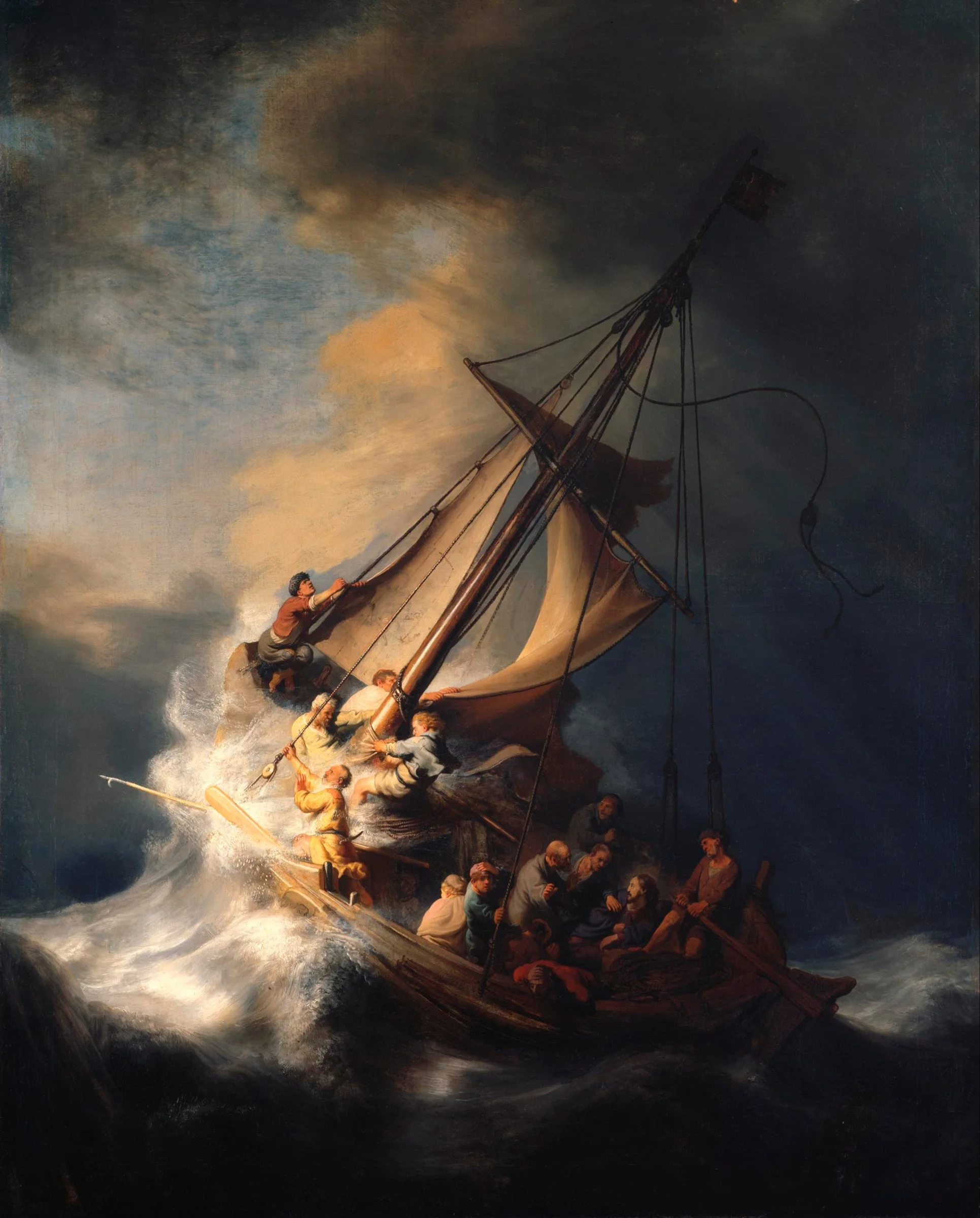 Detail 1
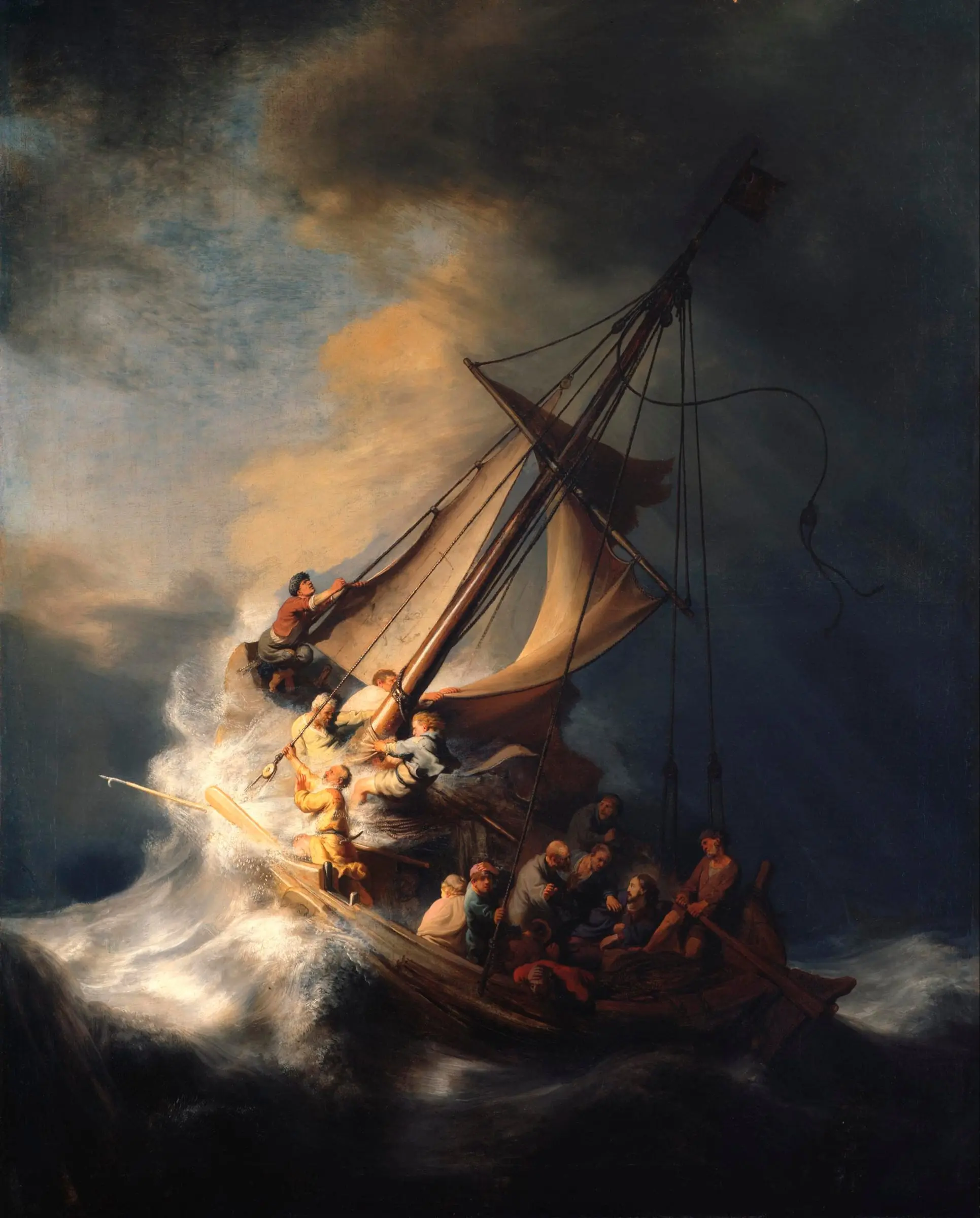
The crashing wave
The bow rises on a huge wave, spray bursting over the deck. The diagonal composition makes the boat seem about to capsize.
Light and darkness
The painting is divided in two by light: the left side, with the bow, the sail and the wave, is lit by a break in the clouds, while the right side, where Christ sits, is in darkness. Rembrandt used this contrast to separate fear and faith, chaos and calm.
Detail 2The torn sail
Disciples struggle to hold the torn sail and the ropes in the light breaking through the storm clouds.
The disciples
Fourteen figures crowd the boat: the twelve disciples, Christ and one more. Some struggle with the ropes and the sail, one is seasick over the side, others cry out in fear, and some turn to Christ, begging him to save them.
Christ and the self-portrait
In the dark stern, Christ sits calm and unafraid, surrounded by disciples who wake him. Among the figures, one man looks straight out at the viewer, holding his cap with one hand and a rope with the other. He is usually identified as a self-portrait of Rembrandt, who placed himself in the boat among the frightened disciples.
Detail 3Christ in the stern
In the shadows at the stern, Christ remains calm while the disciples wake him in fear.
Detail 4Rembrandt in the boat
One figure looks straight at us, holding his cap and a rope. He is usually identified as Rembrandt himself.
The theft
The painting was bought in 1898 by Isabella Stewart Gardner for her museum in Boston. In the early hours of 18 March 1990, two men disguised as police officers entered the museum, tied up the guards and stole thirteen works, including this painting, which they cut from its frame. Despite a reward of ten million dollars, it has never been recovered. Its empty frame still hangs in the Dutch Room of the museum.
The painting measured about 1.6 by 1.3 metres. Today it can only be seen in photographs and in reproductions.
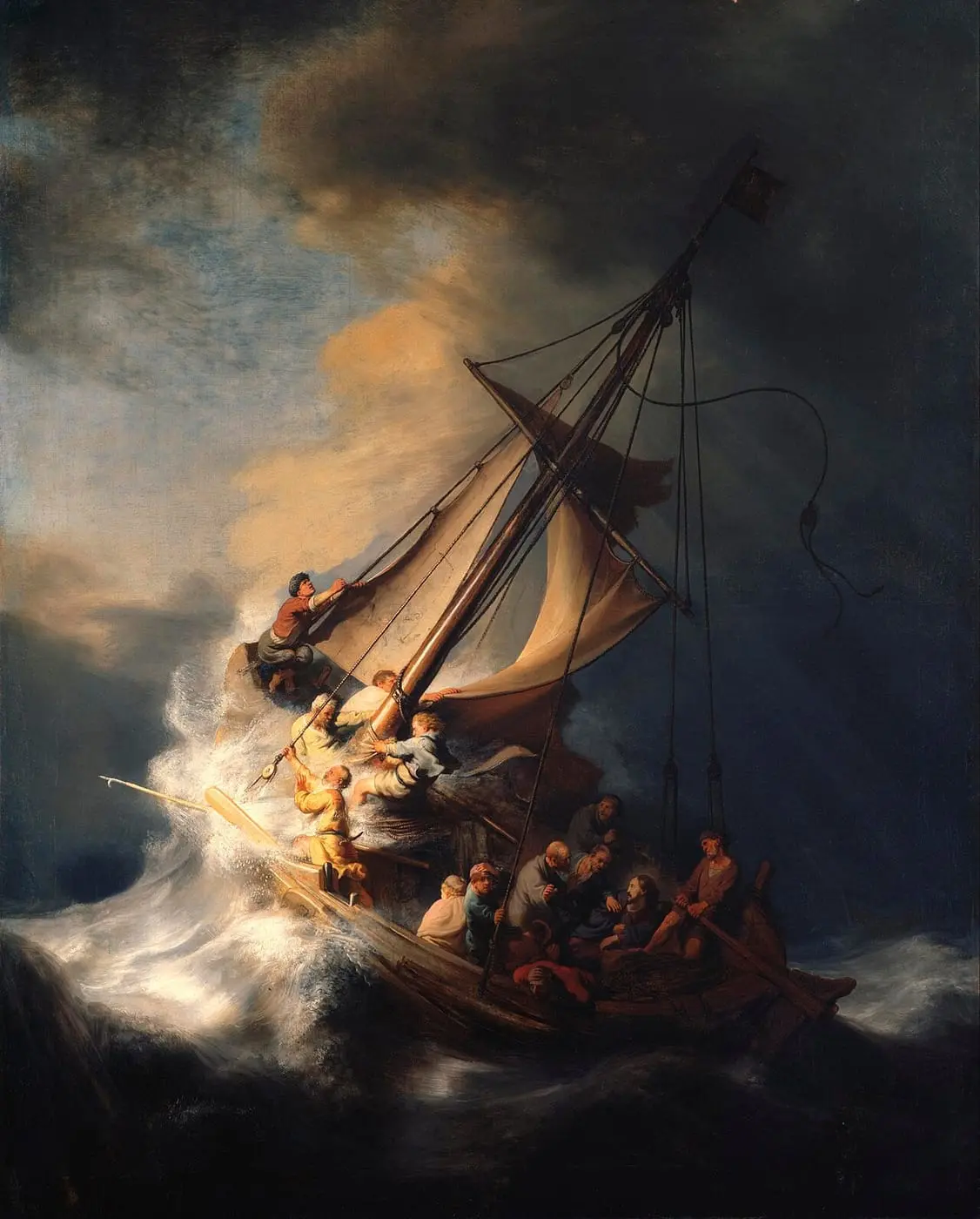
Own a hand-painted copy
The Storm on the Sea of Galilee
Painted by hand in oil on canvas, any size. Free worldwide shipping.
From $299 — Make it yours.Frequently asked questions
Is The Storm on the Sea of Galilee Rembrandt's only seascape?
Yes. It is the only known seascape by Rembrandt, painted in 1633.
Where is The Storm on the Sea of Galilee now?
Nobody knows. It was stolen from the Isabella Stewart Gardner Museum in Boston in 1990 and has never been found.
Is Rembrandt in the painting?
A man looking out at the viewer, holding his cap and a rope, is usually considered a self-portrait.
What is the story of the painting?
It shows the Gospel episode in which Christ calms a storm on the Sea of Galilee.
Sources and further reading
- Isabella Stewart Gardner Museum, records of the 1990 theft
- Gospel of Mark 4:35–41
- Christopher White, Rembrandt (1984)
