

Listen to this article
0:00 / 3:24 · Read by ArtLogia
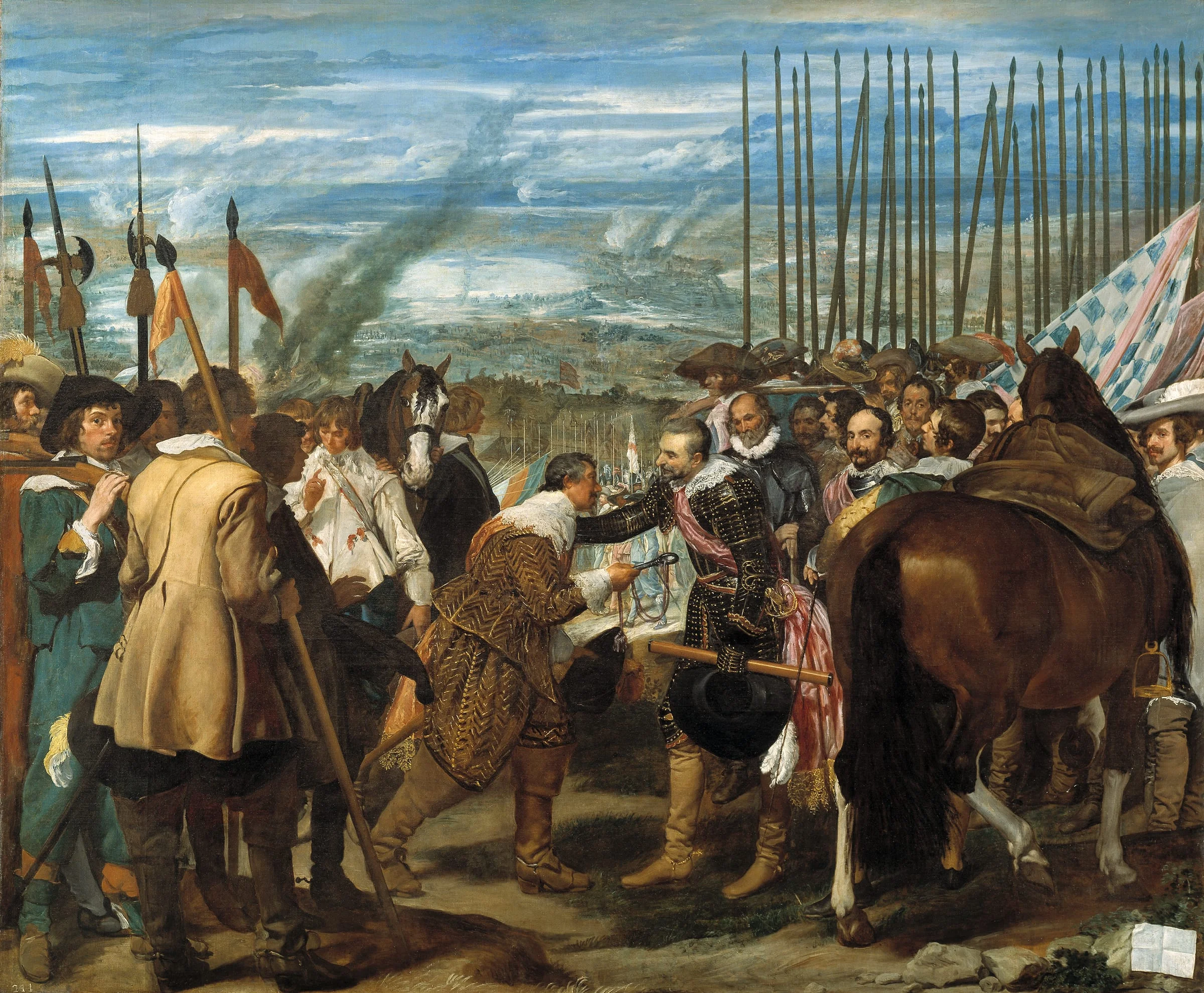
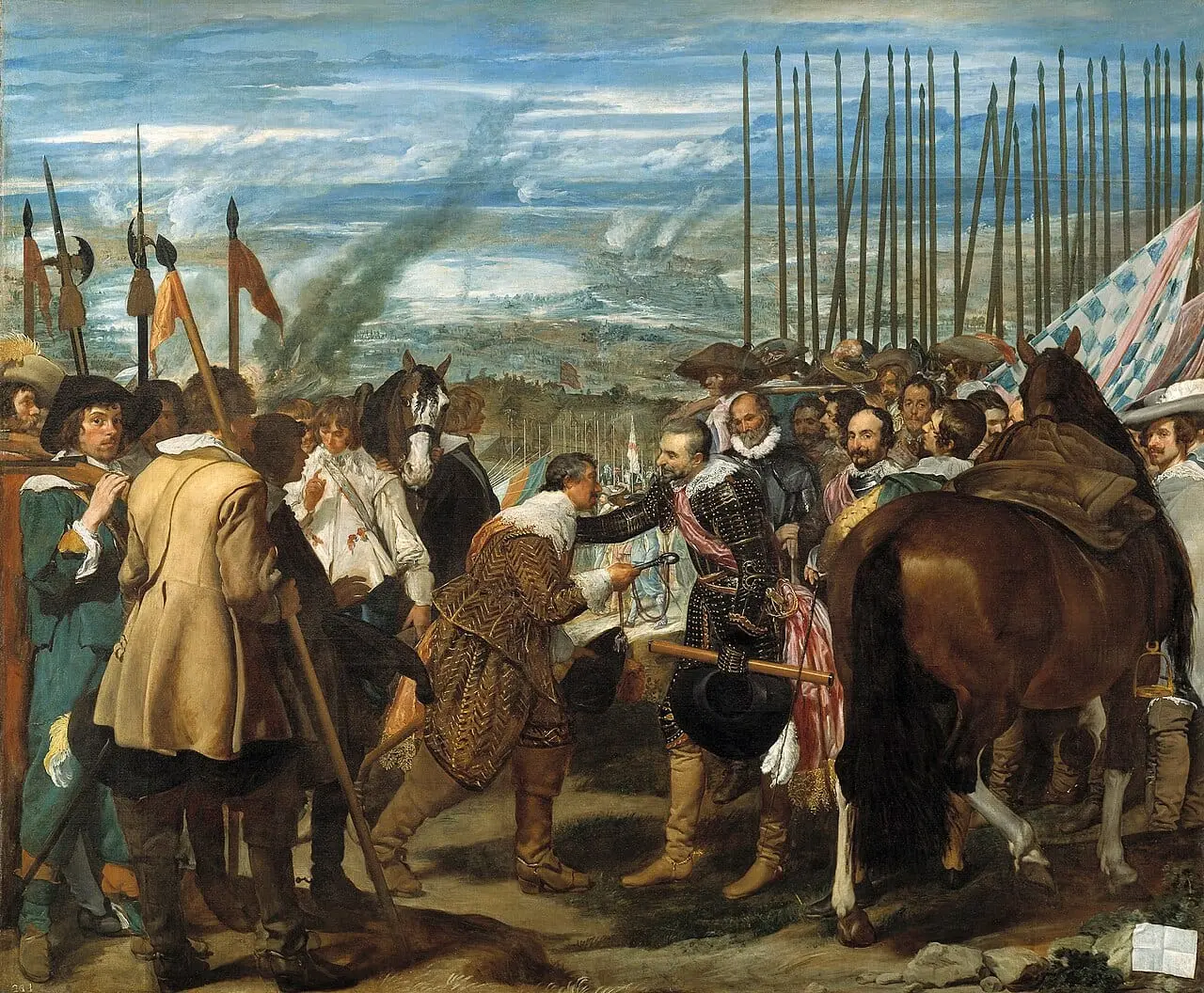
The Dutch governor of Breda hands the keys of the city to the Spanish general Ambrogio Spinola, who leans forward to stop him from kneeling. Painted around 1634–1635, Velázquez's The Surrender of Breda is one of the greatest history paintings ever made, and one of the most humane.
In this article
A victory for the Hall of Realms
In June 1625, after a siege of almost a year, the Dutch fortress city of Breda surrendered to the Spanish army commanded by the Genoese general Ambrogio Spinola, during the long war between Spain and the Dutch Republic. Ten years later, King Philip IV commissioned a series of paintings of Spanish victories for the Hall of Realms in his new palace of the Buen Retiro in Madrid. Diego Velázquez, his court painter, was given the surrender of Breda.
Velázquez had met Spinola, who had travelled with him by ship to Italy in 1629. The general had died in 1630, so the painting was also a tribute to a man the painter had known.
The handing over of the keys
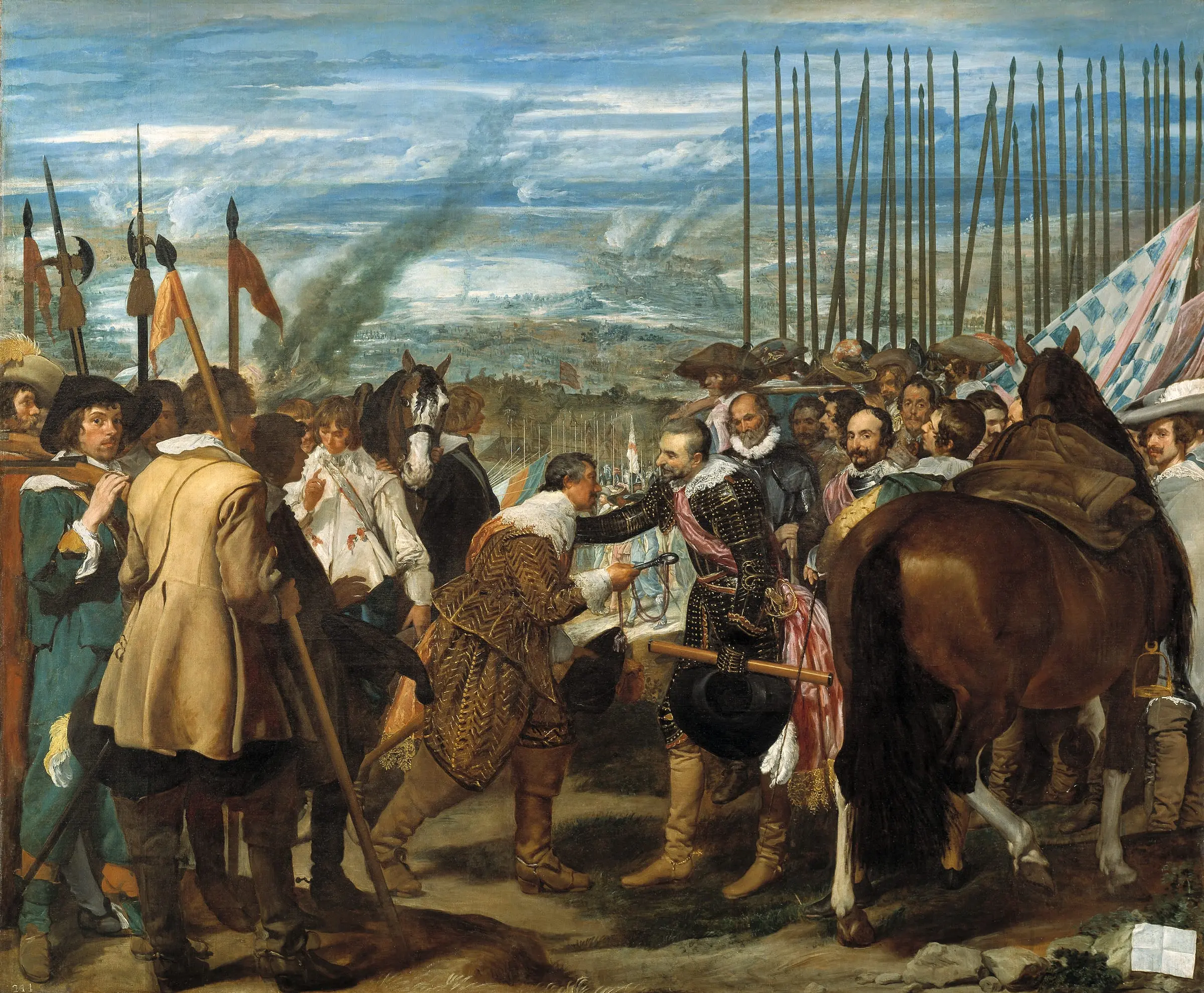
At the centre of the painting, Justin of Nassau, the Dutch governor, bows and offers the keys of the city to Spinola. The victor, in black armour with a red sash, puts his hand on Nassau's shoulder to stop him from kneeling, as if to say that a brave enemy need not humiliate himself. Velázquez based the moment on accounts of the surrender and on a play by Calderón, where Spinola speaks words of respect to the defeated.
 Detail 1
The keys of Breda
Justin of Nassau offers the keys as Spinola lays a hand on his shoulder. The gesture of courtesy turns a military defeat into a scene of mutual respect.
Two armies
On the left stand the Dutch soldiers, with an irregular group of halberds and pikes. On the right stand the Spanish troops, whose long lances rise in an orderly vertical forest that gave the painting its popular Spanish name, Las Lanzas, "The Lances". The contrast suggests the discipline of the Spanish army.
Detail 2The forest of lances
The tall, straight lances of the Spanish troops rise against the sky in a regular rhythm, giving the painting its nickname, Las Lanzas.
The faces of the soldiers
Velázquez painted the soldiers on both sides as individuals, each with his own expression: curiosity, fatigue, indifference. Some look at the ceremony, others out of the painting. The man in the large hat at the far right edge is often said to be a self-portrait of Velázquez.
Detail 3Spinola and his officers
The general's face shows a calm dignity, while the officers behind him watch the ceremony with varied expressions.
The great horse
On the right, the haunches of Spinola's horse fill a large part of the composition, its head turned towards us. The horse balances the scene and gives depth to the Spanish side. Velázquez painted it with a few broad, confident strokes.
Detail 4Spinola's horse
The great bay horse seen from behind anchors the right side of the painting, its glossy coat painted with broad strokes.
The landscape of war
Behind the figures stretches a vast landscape of the Low Countries, with smoke from fires, floods and lines of troops in blue-grey tones. Velázquez painted it with a light, fluid touch, creating a sense of air and distance.
Detail 5Smoke over the plain
Smoke drifts over a wide plain in blue and silver tones. The landscape opens the scene to the world beyond the ceremony.
Seeing the painting
The Surrender of Breda measures about 3.1 by 3.7 metres and hangs in the Museo del Prado in Madrid.
Own a hand-painted copy
The Surrender of Breda
Painted by hand in oil on canvas, any size. Free worldwide shipping.
From $299 — Make it yours.Frequently asked questions
What does The Surrender of Breda show?
It shows the Dutch governor Justin of Nassau handing the keys of Breda to the Spanish general Ambrogio Spinola in 1625.
Why is it called Las Lanzas?
The painting is nicknamed The Lances because of the forest of vertical lances held by the Spanish soldiers.
Who commissioned The Surrender of Breda?
It was painted for King Philip IV's Hall of Realms in the Buen Retiro palace in Madrid.
Where is The Surrender of Breda?
It is in the Museo del Prado in Madrid.
Sources and further reading
- Museo del Prado, collection notes on The Surrender of Breda
- Jonathan Brown and John Elliott, A Palace for a King: The Buen Retiro and the Court of Philip IV (1980)
- Pedro Calderón de la Barca, El sitio de Bredá (1625)
