

Listen to this article
0:00 / 3:34 · Read by ArtLogia
A man in a white shirt raises his arms before a firing squad, his face lit by a lantern, as the bodies of those already shot lie in their blood. Painted in 1814, Goya's The Third of May 1808 transformed the way artists depict war.
In this article
The uprising and the reprisal
On 2 May 1808 the people of Madrid rose against the French troops of Napoleon, who had occupied Spain and placed his brother Joseph on the throne. The uprising was crushed, and during the night and the next morning French soldiers executed hundreds of Spaniards suspected of taking part, on the hills of Príncipe Pío and elsewhere around the city.
Six years later, in 1814, after the French had been driven out, Francisco Goya asked the regency government for funds to commemorate "the most notable and heroic actions of our glorious insurrection against the tyrant of Europe". He painted two large canvases: The Second of May 1808, showing the uprising, and The Third of May 1808, showing the executions.
The man in the white shirt
At the centre of the painting, a man kneels with his arms flung wide, facing the rifles. He wears a white shirt and yellow trousers, lit by a lantern on the ground, and his face shows terror and defiance at once. His pose evokes the crucifixion of Christ, and on his right palm Goya painted a small mark like a stigma.
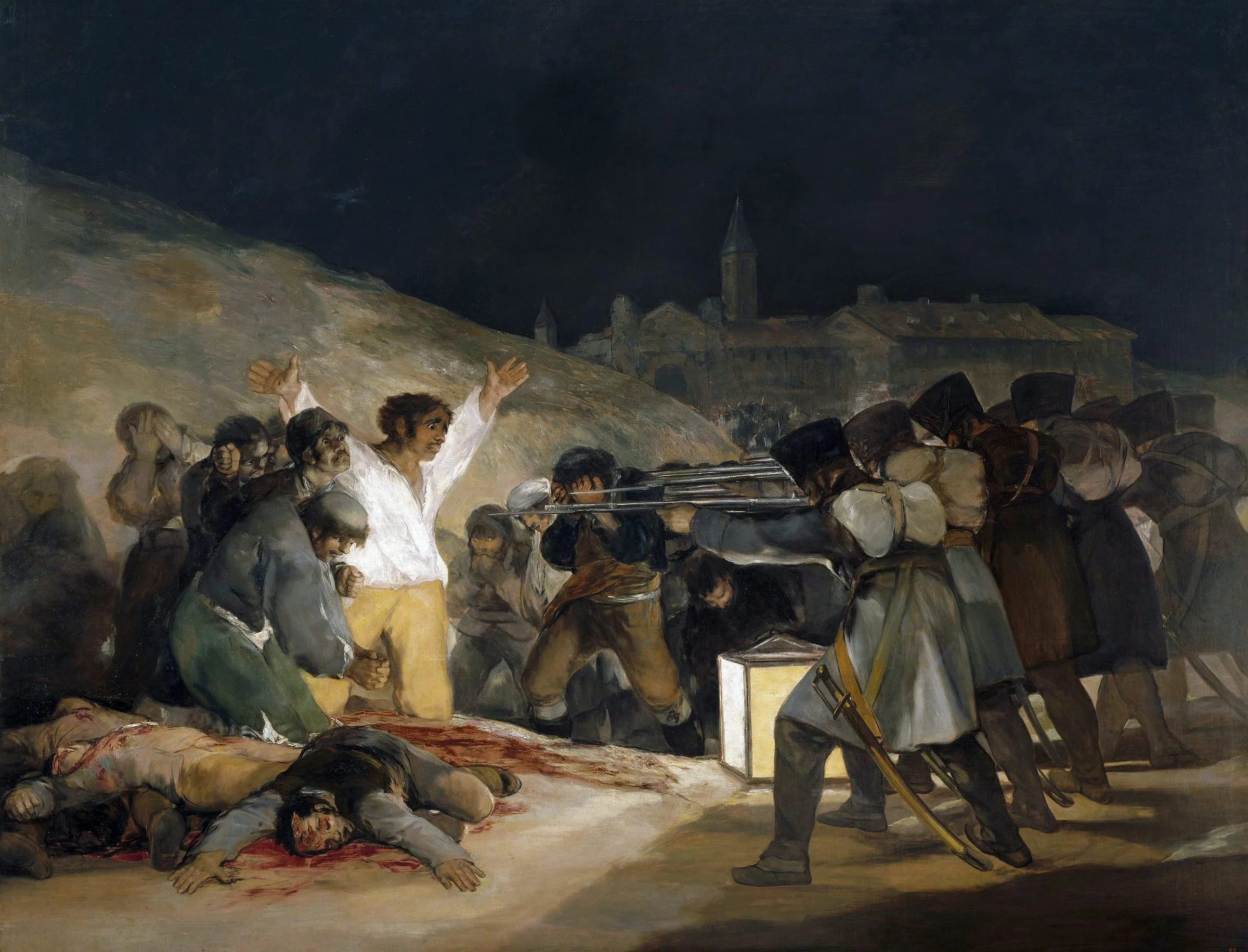 Detail 1
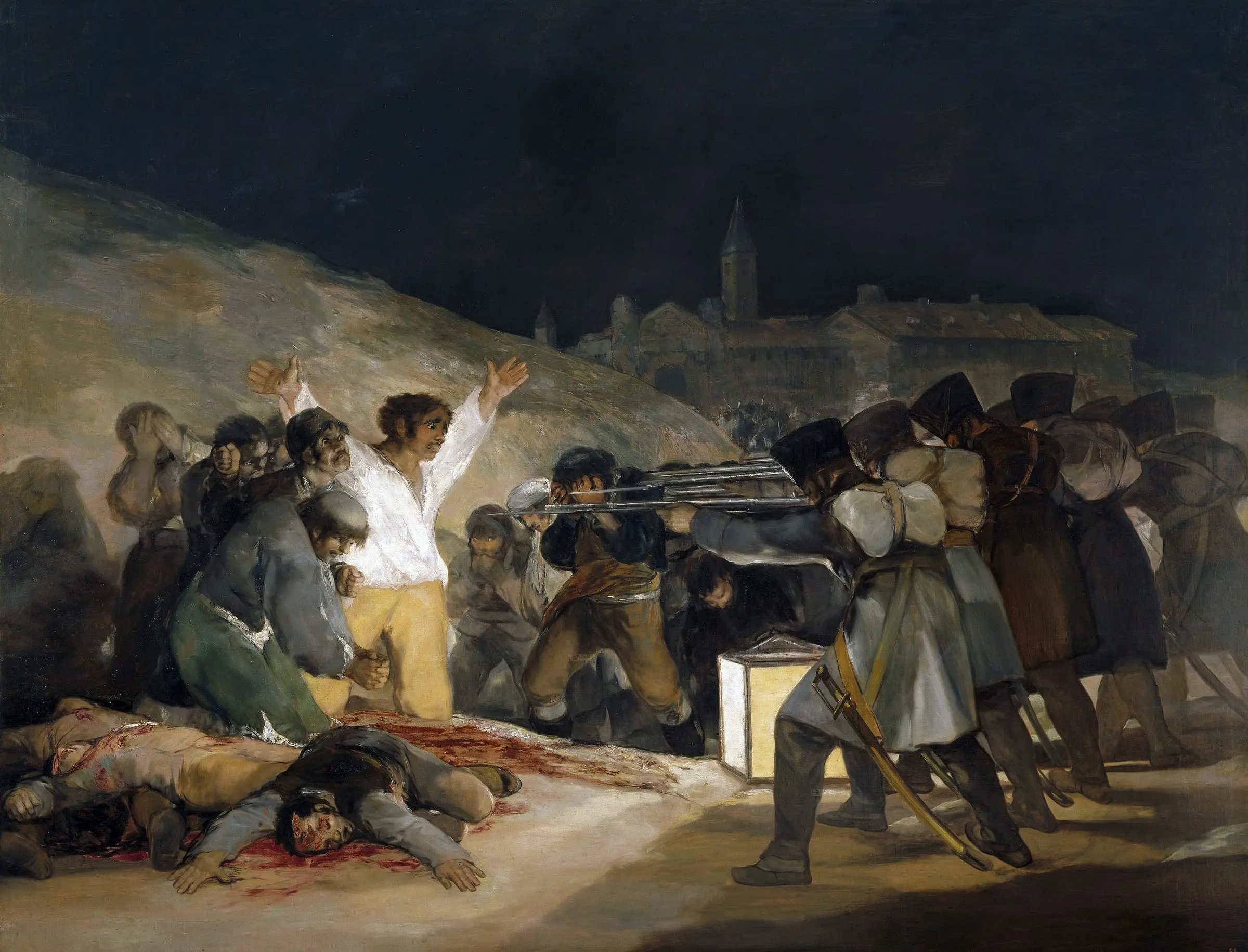
The man with raised arms
The victim's outstretched arms and white shirt make him the brightest point in the painting. His pose recalls the crucified Christ, turning a nameless man into a martyr.
The faceless soldiers
On the right, the French soldiers stand in a tight line, rifles levelled, their faces hidden. Seen from behind, leaning forward in the same pose, they become a machine of death rather than individual men. The contrast between the anonymous executioners and the very human victims is at the heart of the painting's power.
Detail 2The firing squad
The soldiers form a rigid row, their faces turned away from us. Goya denies them individuality, turning them into an impersonal force.
The lantern
A large square lantern on the ground between the soldiers and the victims lights the scene. It is the only source of light in the night, and it falls fully on the man in the white shirt, as if spotlighting him. The darkness around it makes the scene feel like a nightmare.
Detail 3The lantern
The lantern on the ground is the painting's only source of light. It illuminates the victims and leaves the executioners in shadow.
The dead and the waiting
In the foreground, a man lies dead in a pool of blood, his arms spread like those of the central figure. Behind the victim, a line of men walks up the hill towards execution, some covering their faces with their hands. A monk kneels in prayer. Goya shows the whole sequence: those who have died, those who are dying, and those who will die next.
Detail 4The fallen
A dead man lies face down in his own blood at the front of the painting. His spread arms repeat the gesture of the man still alive.
A new kind of war painting
Earlier battle paintings celebrated victories, heroes and generals. Goya shows an anonymous massacre of civilians, without glory or consolation. The painting influenced generations of artists, from Manet's Execution of Emperor Maximilian to Picasso's Guernica and his Massacre in Korea. It is often called the first great modern painting of protest against war.
Seeing The Third of May 1808
The painting measures about 2.7 by 3.5 metres. It hangs in the Museo del Prado in Madrid beside its companion, The Second of May 1808.
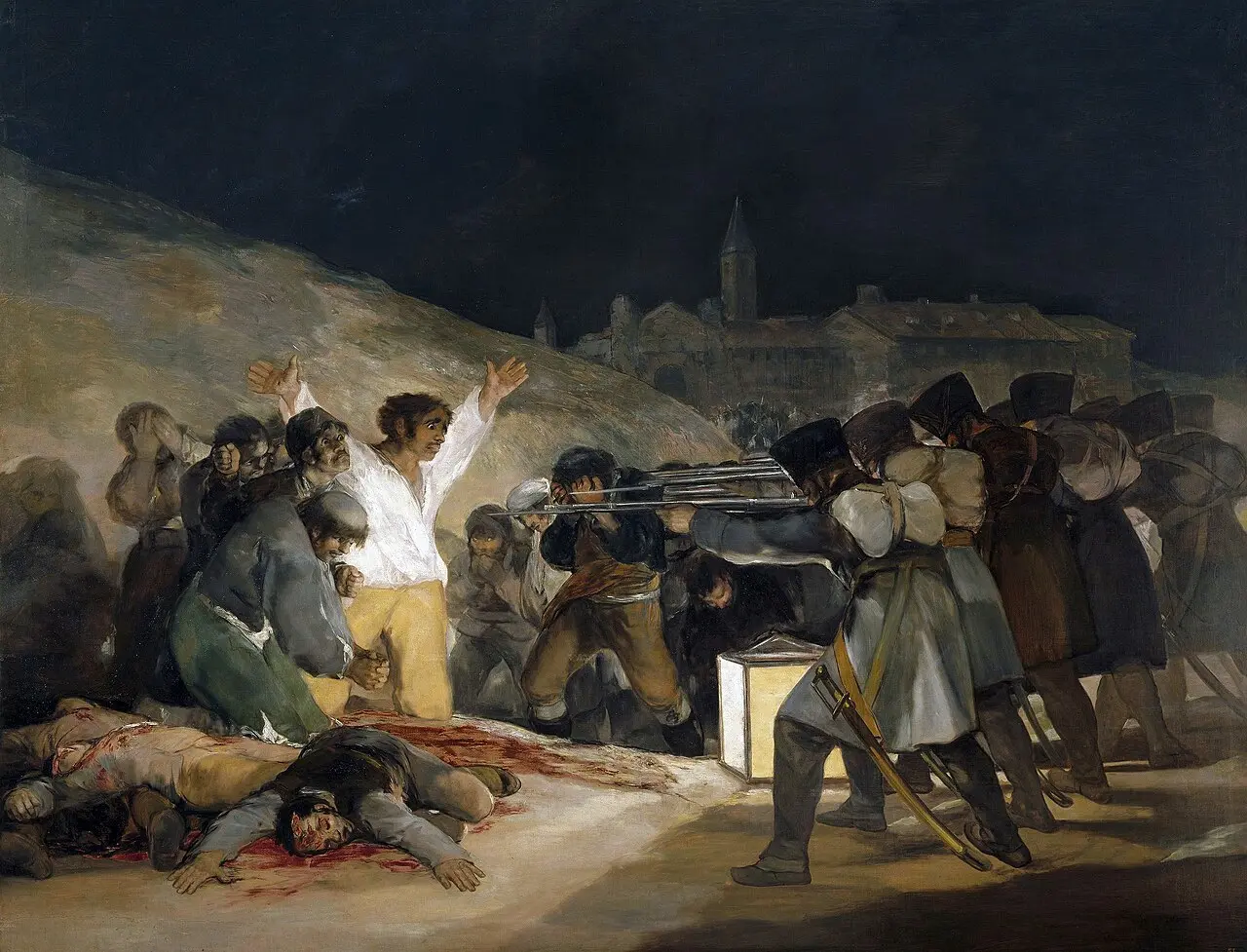
Own a hand-painted copy
The Third of May 1808
Painted by hand in oil on canvas, any size. Free worldwide shipping.
From $299 — Make it yours.Frequently asked questions
What does The Third of May 1808 show?
It shows French soldiers executing Spanish civilians in Madrid after the uprising of 2 May 1808 against Napoleon's occupation.
Who is the man in the white shirt?
He is an anonymous victim; Goya gave him the pose of the crucified Christ, making him a symbol of innocent martyrdom.
When was The Third of May 1808 painted?
Goya painted it in 1814, six years after the events.
Where is The Third of May 1808?
It is in the Museo del Prado in Madrid.
Sources and further reading
- Museo del Prado, collection notes on The Third of May 1808
- Hugh Thomas, Goya: The Third of May 1808 (1972)
- Robert Hughes, Goya (2003)
