


Listen to this article
0:00 / 3:38 · Read by ArtLogia
An army of skeletons invades a burnt landscape, slaughtering kings, peasants, soldiers and lovers alike, herding the living into a giant coffin. Painted around 1562, Pieter Bruegel the Elder's The Triumph of Death is one of the most terrifying visions of mortality in art.
In this article
Death comes for everyone
Pieter Bruegel the Elder painted The Triumph of Death around 1562, in a period of war, religious conflict and plague in the Low Countries. It belongs to a long medieval tradition of images reminding people that death spares no one, such as the Dance of Death, in which skeletons lead people of every class to the grave.
But Bruegel's vision is more violent and overwhelming. The whole landscape is a battlefield, and death arrives not as a single figure but as an army.
The skeleton army
In the centre, legions of skeletons advance in rows, carrying coffin lids as shields, while others drive the living into a huge box-like trap decorated with a cross. Skeletons blow trumpets, ring bells and beat drums, announcing the end.
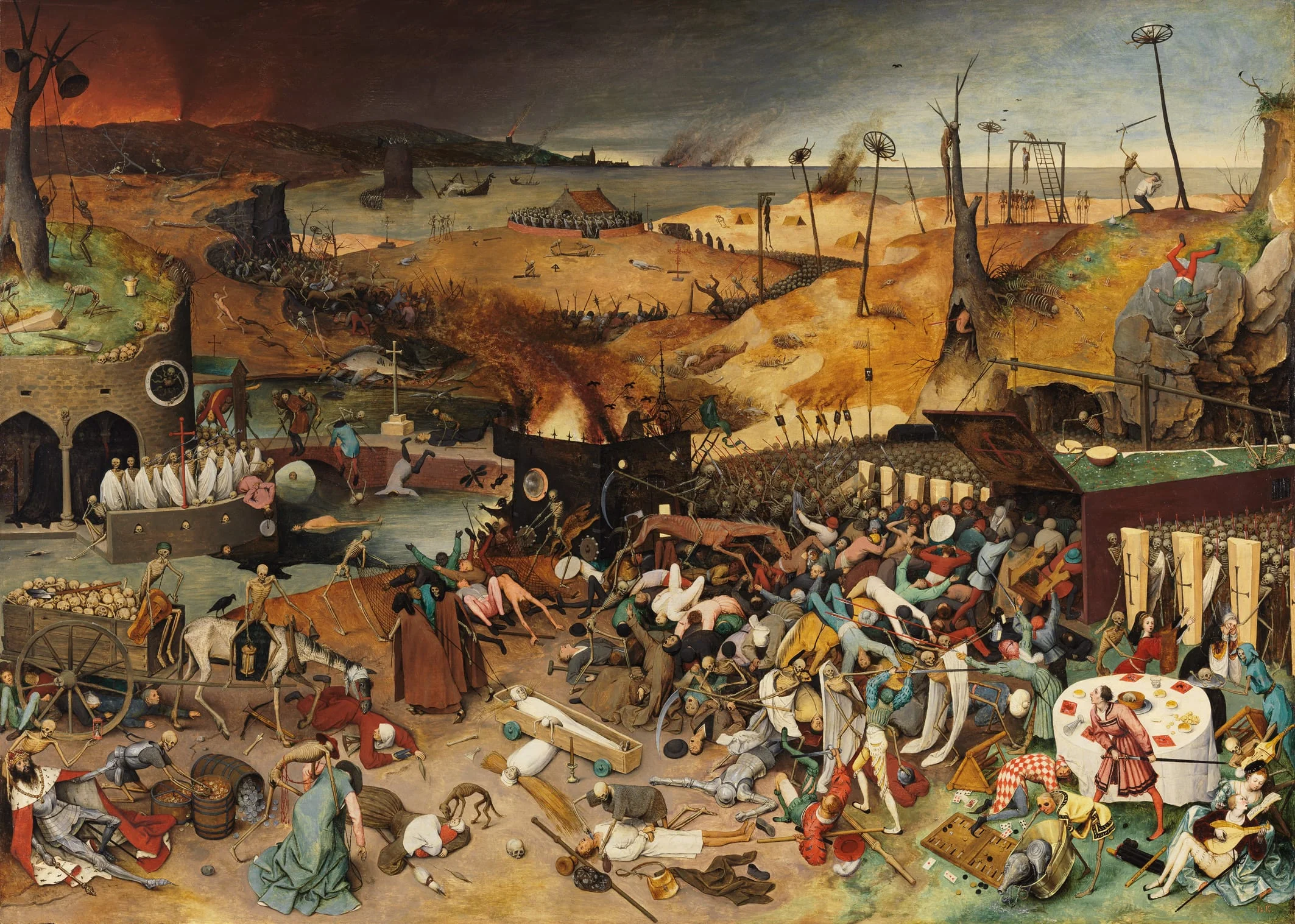 Detail 1
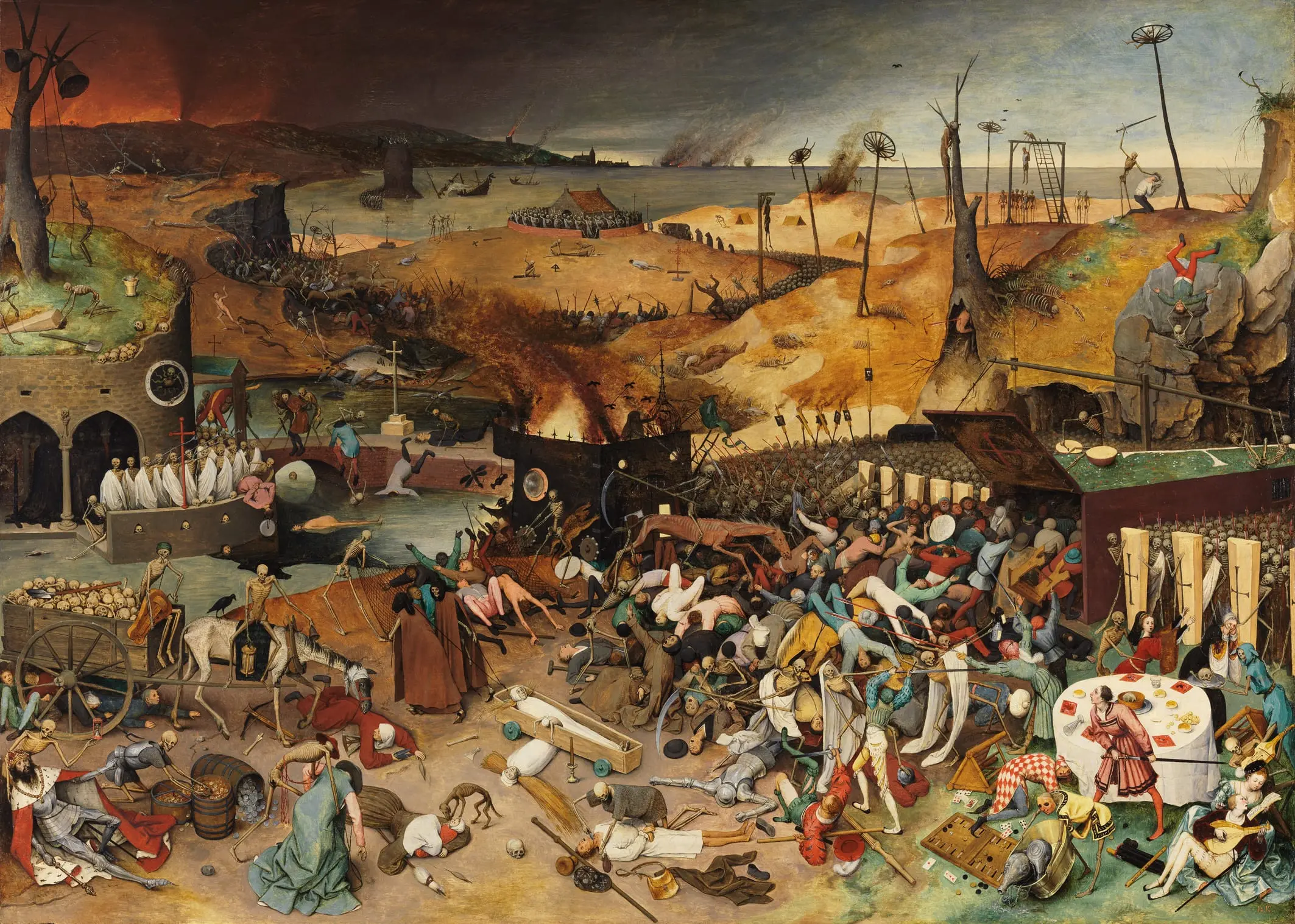
The army of the dead
Rows of skeletons advance behind coffin lids used as shields, driving the living towards a giant trap.
Death on horseback
A skeleton riding a thin, pale horse swings a scythe and cuts down the crowd. He recalls the fourth horseman of the Apocalypse, Death on a pale horse, from the Book of Revelation.
Detail 2Death on a pale horse
A skeleton on a gaunt horse swings a scythe through the crowd, an image drawn from the Book of Revelation.
The dying king
In the lower left corner, a king in a red cloak and ermine collapses, while a skeleton shows him an hourglass, his time has run out, and another helps itself to his barrels of gold coins. Wealth and power cannot save him.
Detail 3The dying king
A king sinks to the ground as a skeleton holds up an hourglass. His treasure is of no use against death.
The lovers
In the lower right corner, a young couple sit absorbed in music, the man playing a lute and the woman singing, unaware of the skeleton behind them who joins in on a violin. They are the only people who have not noticed the catastrophe around them.
Detail 4The oblivious lovers
A young couple make music together, unaware that a skeleton is playing along behind them. Death is about to interrupt their song.
The burning landscape
In the background, the land is barren and burning. Ships sink, gallows and wheels for executions rise on the hills, fires burn on the horizon and bells toll. It is a world without hope, painted in browns, reds and blacks.
Detail 5A burning world
On the horizon, fires burn, ships sink and gallows stand on the hills. The whole world is consumed by death.
A restoration
The Prado restored the painting in 2018, removing old varnishes and overpaintings, and revealing details and colours hidden for centuries. The painting measures about 1.17 by 1.62 metres and hangs in the Museo del Prado in Madrid, near Bosch's Garden of Earthly Delights.
The influence of Bosch
The Triumph of Death shows how much Bruegel owed to Hieronymus Bosch, whose nightmarish visions of Hell were still popular in the Low Countries half a century after his death. But Bruegel transformed the tradition: instead of a fantastical underworld, he shows death invading the real world, with its kings, soldiers, peasants and lovers. The painting reflects the anxieties of an age of war, epidemics and religious conflict, when death could come suddenly to anyone. Its countless details reward close looking: a skeleton playing a hurdy-gurdy, a cardinal led away, a dog nibbling at a corpse, a pilgrim with his throat cut. It is a vast catalogue of mortality and one of the darkest masterpieces of Northern Renaissance art.
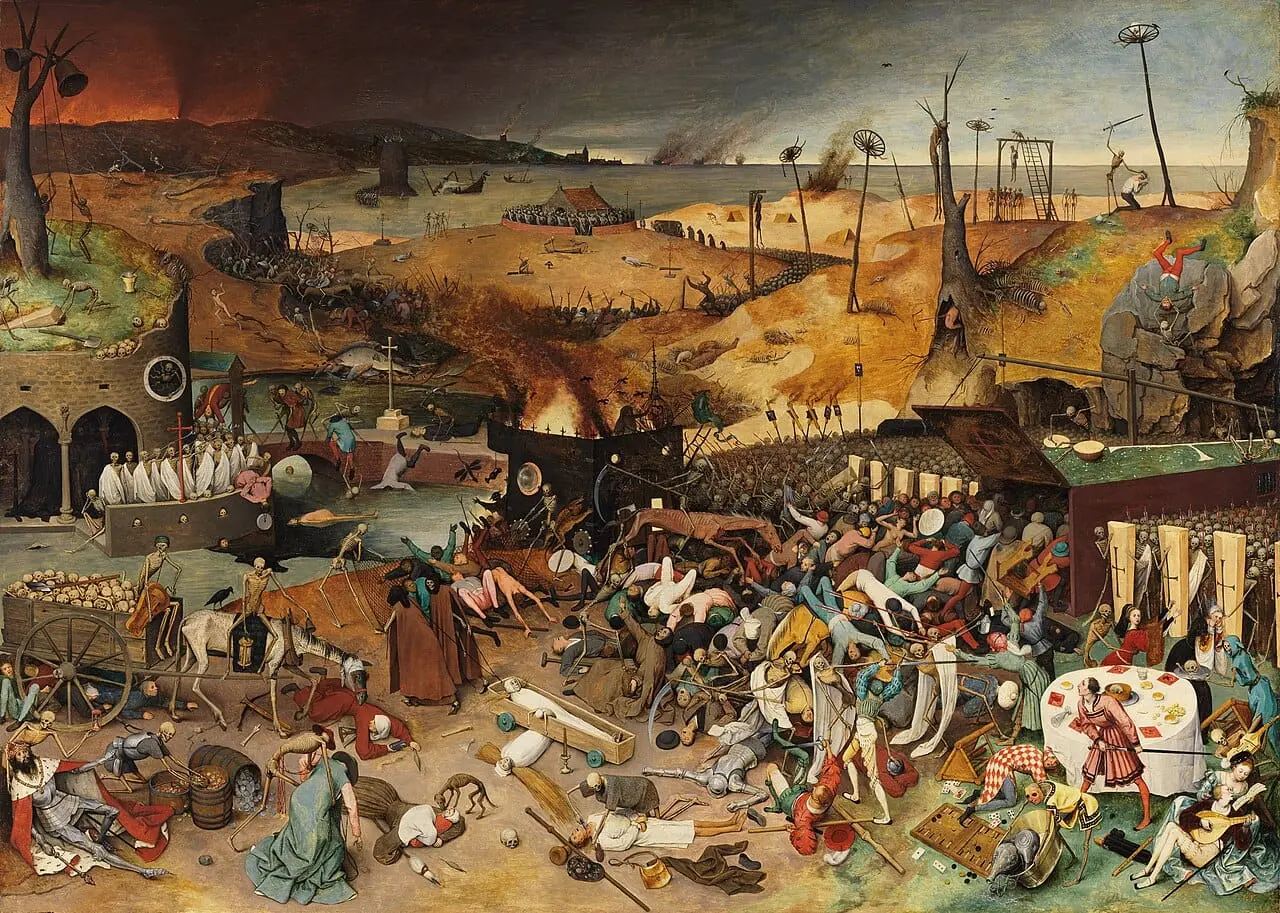
Own a hand-painted copy
The Triumph of Death
Painted by hand in oil on canvas, any size. Free worldwide shipping.
From $299 — Make it yours.Frequently asked questions
What does The Triumph of Death show?
It shows an army of skeletons destroying people of every class, a vision of the universality of death.
When was The Triumph of Death painted?
Pieter Bruegel the Elder painted it around 1562.
What do the lovers in the corner mean?
The couple making music are absorbed in each other and unaware of death, a reminder that no one can escape it.
Where is The Triumph of Death?
It is in the Museo del Prado in Madrid.
Sources and further reading
- Museo del Prado, collection notes and restoration report on The Triumph of Death (2018)
- Manfred Sellink, Bruegel: The Complete Paintings, Drawings and Prints (2007)
- Reindert Falkenburg, essays on Bruegel's moral imagery
