

Listen to this article
0:00 / 3:30 · Read by ArtLogia
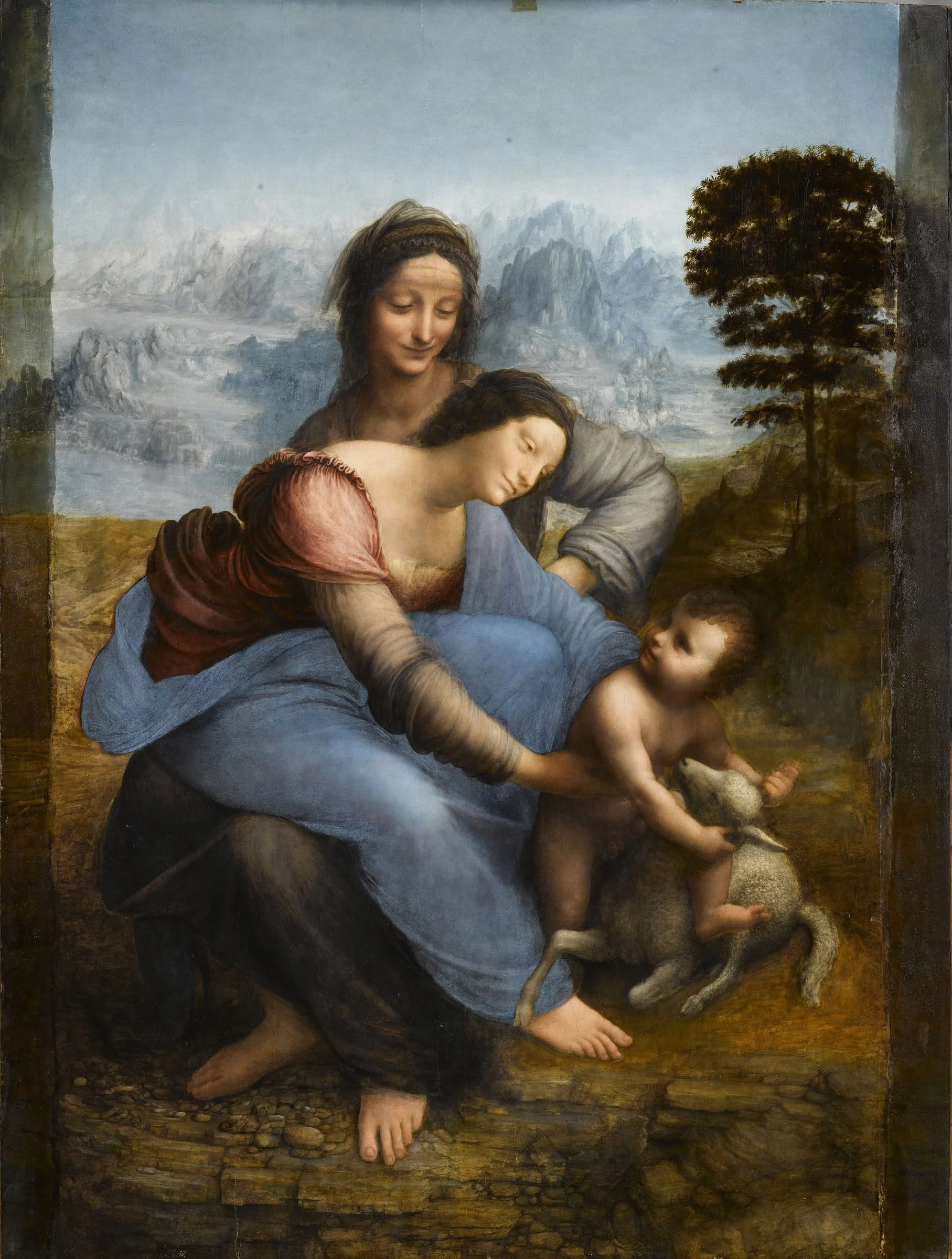
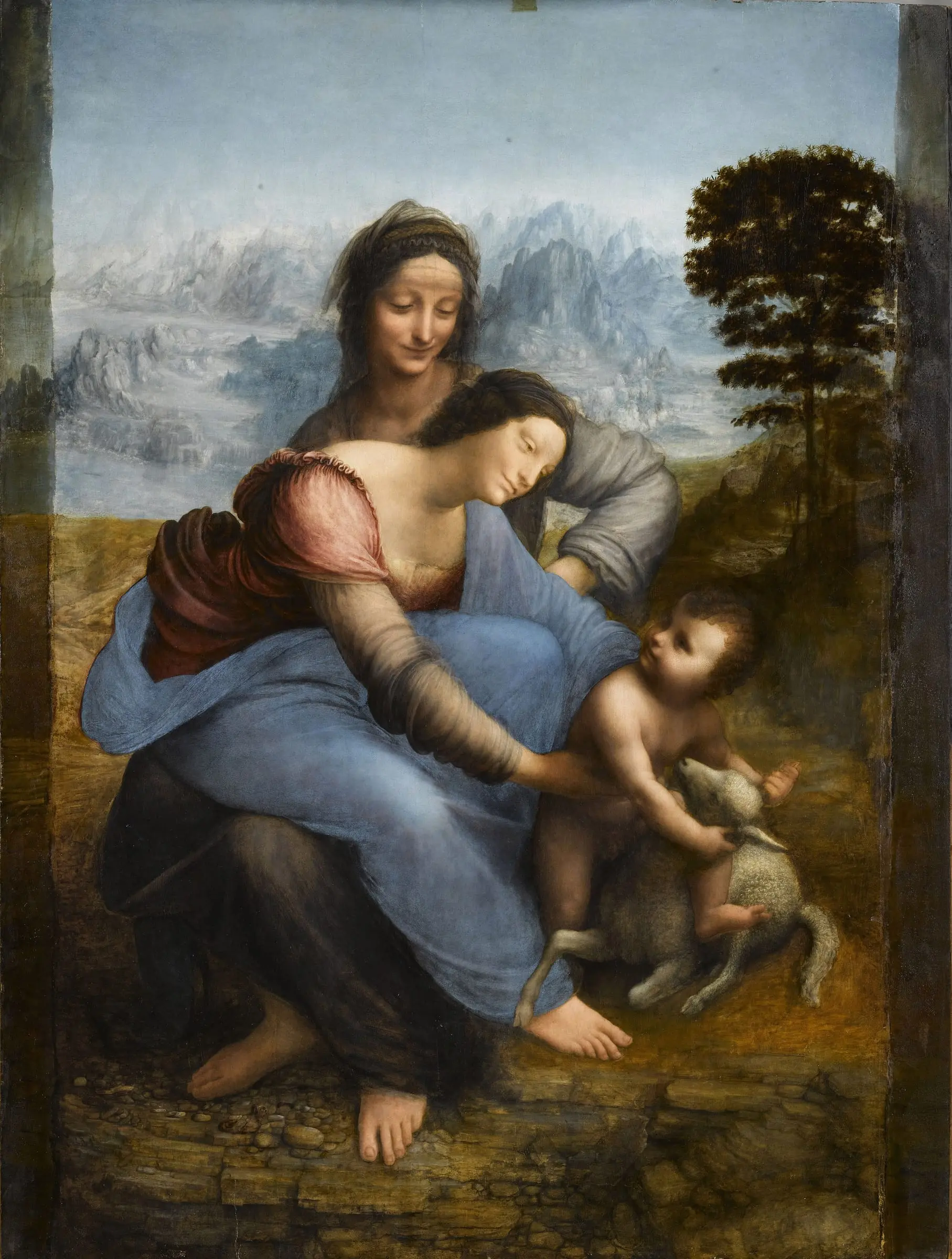
The Virgin Mary sits on her mother's lap and reaches for the infant Jesus, who is playing with a lamb, while Saint Anne smiles above them before a misty mountain landscape. Leonardo da Vinci worked on this painting from around 1503 until his death in 1519.
In this article
A painting of a lifetime
Around 1500, Leonardo da Vinci began exploring a new subject: Saint Anne, the mother of the Virgin Mary, with her daughter and the infant Christ. He made a large drawing, the Burlington House Cartoon now in the National Gallery in London, and a cartoon exhibited in Florence in 1501, which crowds came to admire. The painting itself was begun around 1503 and occupied him, on and off, for the rest of his life. It was still in his studio in France when he died in 1519.
The result is one of the most harmonious and moving works of the Renaissance, and one of the last masterpieces of Leonardo's career.
A pyramid of figures
The three figures form a single pyramid, with Saint Anne at the top. Mary sits on her mother's lap, leaning forward towards her son, who has climbed down to play with a lamb. The bodies are interlocked so closely that they seem to flow into each other, a composition of great complexity that appears completely natural.
Two smiles
Saint Anne looks down at her daughter with a gentle, knowing smile, the same mysterious smile found in the Mona Lisa and Saint John the Baptist. Mary's face is softer and younger, turned with tenderness towards her child. The two faces, painted with the finest sfumato, are among the most beautiful Leonardo ever painted.
 Detail 1
Saint Anne's smile
Saint Anne gazes down with a serene, enigmatic smile. Her face is modelled with soft shadows that melt into one another.
Detail 2Mary's tenderness
The Virgin leans forward to take her son, her face full of love. Her pose is the link between her mother above and the child below.
The child and the lamb
The infant Jesus holds a lamb by the ear and turns to look at his mother. The lamb is a symbol of the Passion, Christ's future sacrifice as the Lamb of God. Mary seems to want to hold him back from his destiny, while Saint Anne, symbol of the Church, accepts it calmly.
Detail 3The lamb of sacrifice
The child plays with the lamb, a symbol of his future sacrifice. The animal's wool and the child's soft skin are painted with great care.
The landscape and the ground
Behind the figures rises a strange landscape of blue mountains and rocky peaks, dissolving into mist, painted with the atmospheric perspective Leonardo studied all his life. At the bottom, the figures stand on a rocky ground scattered with pebbles, which Leonardo painted with geological precision.
Detail 4Blue mountains in the mist
The peaks fade into blue haze, a landscape that seems both real and visionary.
Detail 5Bare feet and pebbles
Mary's bare feet rest on rocky ground strewn with pebbles, studied with the eye of a naturalist.
A delicate restoration
The painting was restored in 2010–2012, removing old varnishes that had turned yellow. The cleaning revealed brighter colours and the luminous blue of Mary's cloak, and was the subject of an exhibition at the Louvre in 2012. The restoration was controversial, as some experts felt it had gone too far, but it allowed visitors to see the subtlety of Leonardo's colours again.
Seeing the painting
The painting measures about 1.68 by 1.12 metres, painted in oil on a poplar panel. It is in the Musée du Louvre in Paris, in the Grande Galerie near Leonardo's other works.
Own a hand-painted copy
The Virgin and Child with Saint Anne
Painted by hand in oil on canvas, any size. Free worldwide shipping.
From $299 — Make it yours.Frequently asked questions
Who is in The Virgin and Child with Saint Anne?
It shows Saint Anne, her daughter the Virgin Mary, and the infant Jesus playing with a lamb.
What does the lamb symbolise?
The lamb symbolises Christ's future sacrifice, his Passion and death.
How long did Leonardo work on it?
He worked on it from around 1503 until his death in 1519.
Where is The Virgin and Child with Saint Anne?
It is in the Musée du Louvre in Paris.
Sources and further reading
- Musée du Louvre, collection notes on The Virgin and Child with Saint Anne
- Vincent Delieuvin (ed.), La Sainte Anne, l'ultime chef-d'œuvre de Léonard de Vinci (Louvre, 2012)
- Frank Zöllner, Leonardo da Vinci: The Complete Paintings (2003)
