Listen to this article
0:00 / 3:33 · Read by ArtLogia
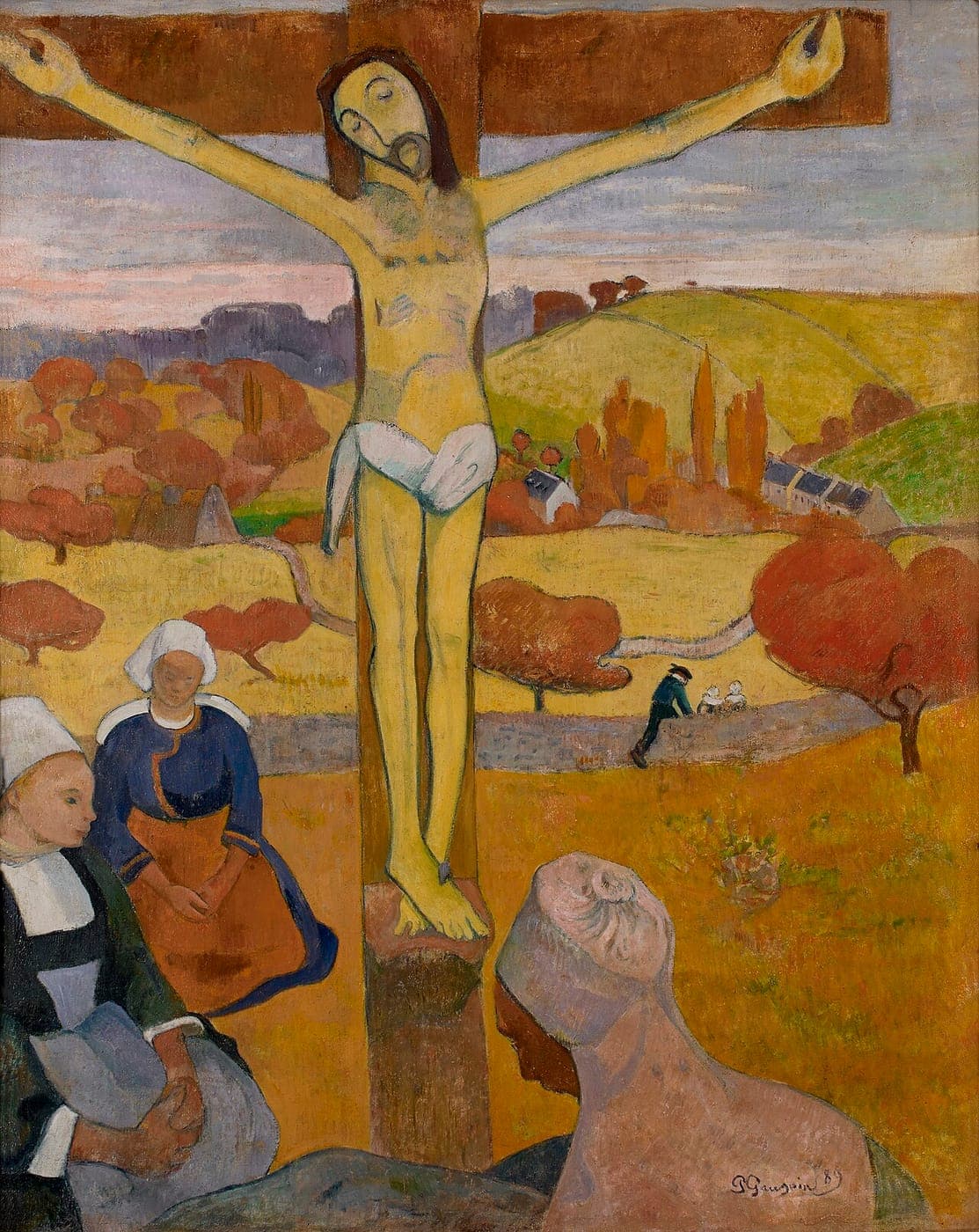
A yellow Christ hangs on the cross in the Breton countryside, surrounded by peasant women in traditional costume, under trees turned red and orange. Paul Gauguin painted The Yellow Christ in 1889 in Pont-Aven, a manifesto of his new, symbolic style.
In this article
Brittany and Pont-Aven
In the late 1880s Paul Gauguin spent long periods in Brittany, in the village of Pont-Aven and nearby Le Pouldu. He was drawn by the region's cheap living, its rugged landscapes and above all its traditional, deeply religious culture, which seemed to him more primitive and authentic than modern Paris. Around him gathered a group of young painters known as the School of Pont-Aven.
In 1889 Gauguin painted The Yellow Christ, inspired by a seventeenth-century wooden crucifix in the chapel of Trémalo near Pont-Aven, which still hangs there today.
A yellow Christ
Christ hangs on the cross in the middle of the landscape, his body painted a flat, bright yellow, the same colour as the fields around him. The figure is simplified, almost carved, like the wooden statue that inspired it. Gauguin chose yellow not for realism but for its emotional and symbolic power, linking Christ with the harvest and the earth.
 Detail 1

The face of Christ
Christ's face is simplified, with closed eyes and a calm expression, like the wooden crucifix of Trémalo that inspired it.
The Breton women
At the foot of the cross, three Breton women in traditional black dresses and white caps sit or kneel in prayer. They do not seem to see Christ, as if he were a vision in their minds rather than a real presence. Gauguin was interested in the women's simple, intense faith.
Detail 2Breton women in prayer
Peasant women in white caps sit in prayer at the foot of the cross, absorbed in their devotion.
Cloisonnism
The painting is built from flat areas of strong colour surrounded by dark outlines, a style called Cloisonnism, after the cloisonné technique of enamelwork, and inspired by stained glass and Japanese prints. Gauguin and Émile Bernard developed it in Pont-Aven. It rejects the Impressionists' observation of light for a simplified, symbolic vision.
The autumn landscape
Behind the cross, the Breton landscape glows with autumn colours: red and orange trees, yellow fields, a village and a stone wall. The colours are not natural; they are chosen to create harmony and emotion.
Detail 3Autumn trees
The trees glow red and orange around the yellow fields. Gauguin chose colours for their emotional effect rather than their accuracy.
Detail 4A man climbing the wall
In the background, a small figure climbs over a stone wall, a note of everyday life in the landscape.
Christ and Gauguin
Soon after, Gauguin painted his Self-Portrait with the Yellow Christ, in which he placed himself in front of the painting, identifying with the suffering Christ as an artist rejected by society.
Gauguin's search for the primitive
In Brittany, Gauguin wrote that he found the wild and the primitive, and that the dull, muffled sound of his clogs on the granite was the sound he was looking for in his painting. He was looking for an art that would express feelings and ideas directly, through simplified forms and bold, symbolic colour, rather than imitating the visible world as the Impressionists did. The Yellow Christ is one of the first full statements of this approach, which he and his friends called Synthetism. The flat colours, the dark outlines and the decorative composition would influence the Nabis, the Fauves and the Expressionists. Two years later Gauguin left for Tahiti, continuing the same search in a more distant culture.
Seeing The Yellow Christ
The painting measures about 92 by 73 centimetres and is in the Buffalo AKG Art Museum in Buffalo, New York.
Own a hand-painted copy
The Yellow Christ
Painted by hand in oil on canvas, any size. Free worldwide shipping.
From $299 — Make it yours.Frequently asked questions
What inspired The Yellow Christ?
Gauguin was inspired by a 17th-century wooden crucifix in the chapel of Trémalo near Pont-Aven in Brittany.
Why is Christ yellow?
Gauguin used yellow for its symbolic and emotional power, linking Christ to the autumn fields, not for realism.
What is Cloisonnism?
It is a style of flat areas of colour outlined in dark lines, inspired by cloisonné enamel and stained glass, used by Gauguin and Émile Bernard.
Where is The Yellow Christ?
It is in the Buffalo AKG Art Museum in Buffalo, New York.
Sources and further reading
- Buffalo AKG Art Museum, collection notes on The Yellow Christ
- Belinda Thomson, Gauguin (1987)
- Caroline Boyle-Turner, Gauguin and the School of Pont-Aven (1986)
