Listen to this article
0:00 / 3:00 · Read by ArtLogia
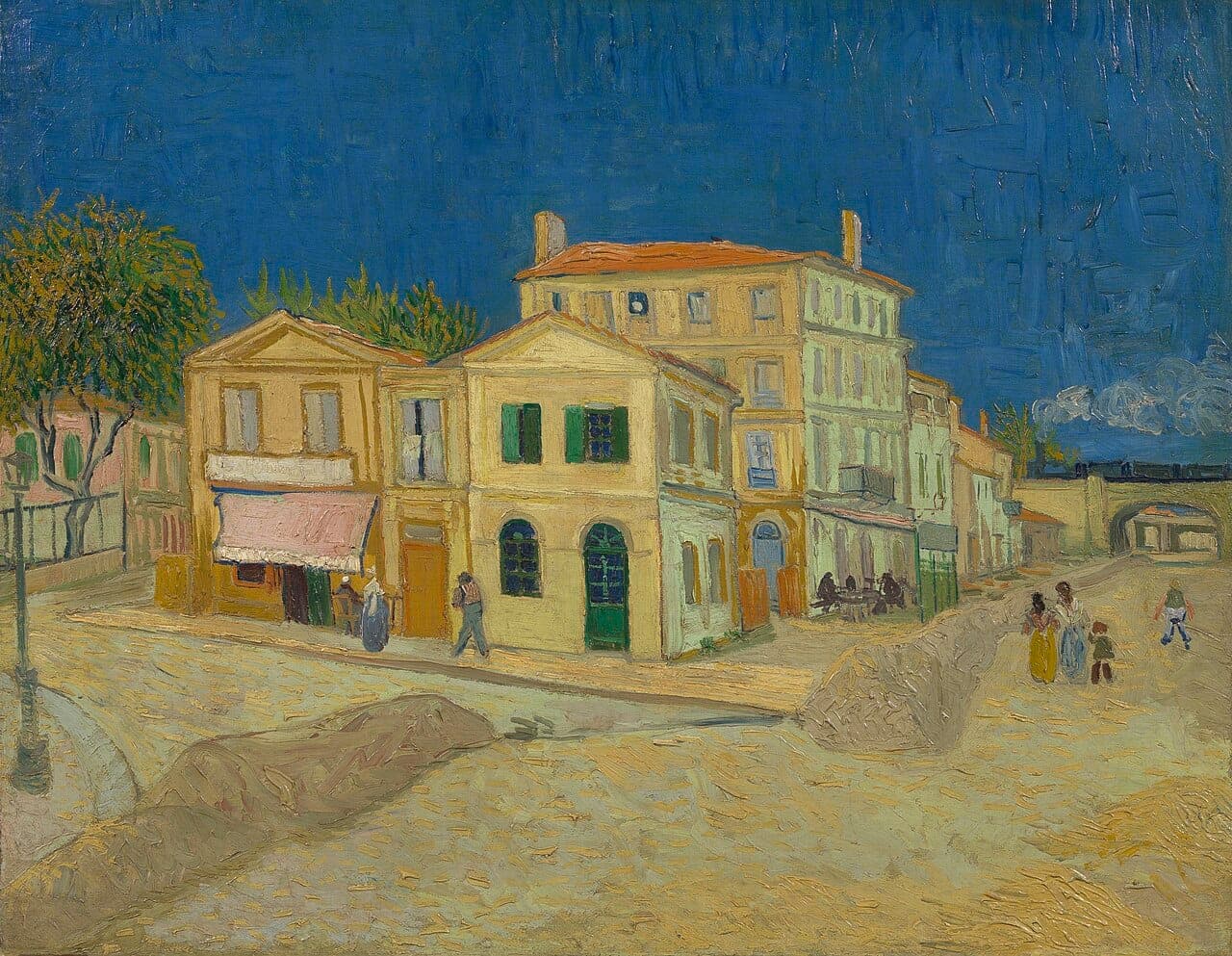
A yellow house with green shutters stands on a sunny corner of the Place Lamartine in Arles, under a deep blue sky, with a train crossing a bridge behind it. Van Gogh rented four rooms in this house in 1888, hoping to found a community of artists.
In this article
A house of his own
In May 1888 Vincent van Gogh rented four rooms in a yellow house at 2 Place Lamartine in Arles, near the railway station. After years of living in rented rooms, this was the first home he could call his own. He painted the walls white inside, bought furniture and decorated the rooms with his paintings, including the Sunflowers, made to welcome Paul Gauguin.
His dream was to create a "Studio of the South", a community of artists working together in the light of Provence. Gauguin arrived in October 1888, but the two men argued fiercely, and the experiment ended in December with Van Gogh's breakdown.
The yellow house
The house is on the left of the painting, on the corner, with green shutters and a green door. Van Gogh lived in the right-hand part of the building. He wrote to Theo that he wanted to paint it under a sulphur sun and a pure cobalt sky, and that the subject was terribly difficult, which was exactly why he wanted to conquer it.
 Detail 1

The house with green shutters
Van Gogh's home stands on the corner, its yellow walls and green shutters glowing in the sun. Behind the right-hand window was his studio.
The restaurant
On the ground floor of the house next door, with a pink awning, was the restaurant of the widow Venissac, where Van Gogh took his meals. Small figures sit or walk outside it, painted with just a few strokes.
Detail 2The restaurant's pink awning
Next to the house, a restaurant shelters under a pink awning. Van Gogh ate his meals here during his time in Arles.
The train on the bridge
In the background on the right, a train passes over a railway bridge, a puff of smoke rising above it. Trains and modern life fascinated Van Gogh, who had travelled south by rail from Paris. The detail places the house close to the station and to the modern world.
Detail 3A train crossing the bridge
A small train with a plume of smoke crosses the railway bridge behind the houses, a sign of modern life in the old town.
The cobalt sky
The sky is an intense, almost dark cobalt blue, contrasting dramatically with the yellow buildings and the sandy street. Van Gogh deliberately pushed the blue to make the yellow glow, using the complementary contrast that drives so many of his works from Arles.
Detail 4A cobalt sky
The deep blue sky makes the yellow walls blaze. Van Gogh wanted a sky of "pure cobalt" over a sun-drenched street.
The fate of the house
The yellow house was damaged by bombing in June 1944 and later demolished. Today only the square and a few nearby buildings remain, and visitors to Arles can stand at the corner where Van Gogh once lived. The painting, about 72 by 91.5 centimetres, is in the Van Gogh Museum in Amsterdam.
Own a hand-painted copy
The Yellow House
Painted by hand in oil on canvas, any size. Free worldwide shipping.
From $299 — Make it yours.Frequently asked questions
Did Van Gogh live in the Yellow House?
Yes. He rented four rooms in the house at 2 Place Lamartine in Arles from May 1888 until his breakdown in December.
What was the Studio of the South?
It was Van Gogh's dream of a community of artists working together in Arles; Gauguin joined him for two months in 1888.
Does the Yellow House still exist?
No. It was damaged in a bombing raid in 1944 and later demolished.
Where is The Yellow House painting?
It is in the Van Gogh Museum in Amsterdam.
Sources and further reading
- Van Gogh Museum, collection notes on The Yellow House (The Street)
- Vincent van Gogh, letters to Theo van Gogh, September 1888
- Martin Bailey, Studio of the South: Van Gogh in Provence (2016)
