


Listen to this article
0:00 / 3:28 · Read by ArtLogia
A young woman reclines on a white sheet, holding roses, while a small dog sleeps at her feet and two maids search a chest in the background. Painted in 1538, Titian's Venus of Urbino set the model for the reclining nude for centuries, from Goya to Manet.
In this article
A painting for a duke
In 1538 Guidobaldo della Rovere, the son of the Duke of Urbino, bought a painting of a reclining woman from Titian, the greatest painter of Venice. In his letters he called it simply "the naked woman". He became duke a few months later, and the painting is now known as the Venus of Urbino.
Titian was inspired by Giorgione's Sleeping Venus, which he had helped to finish about thirty years earlier, but he made two decisive changes: he moved the goddess from a landscape into a palace, and he opened her eyes.
The face and the gaze
The woman lies on a bed of white sheets and red cushions, her head propped on pillows. She looks out at the viewer with a calm, direct, slightly playful gaze. Her identity is unknown; she may have been a courtesan or a model, and the same face appears in other works by Titian. Her golden-red hair falls over her shoulder, a colour so typical of Venetian painting that it is still called Titian red.
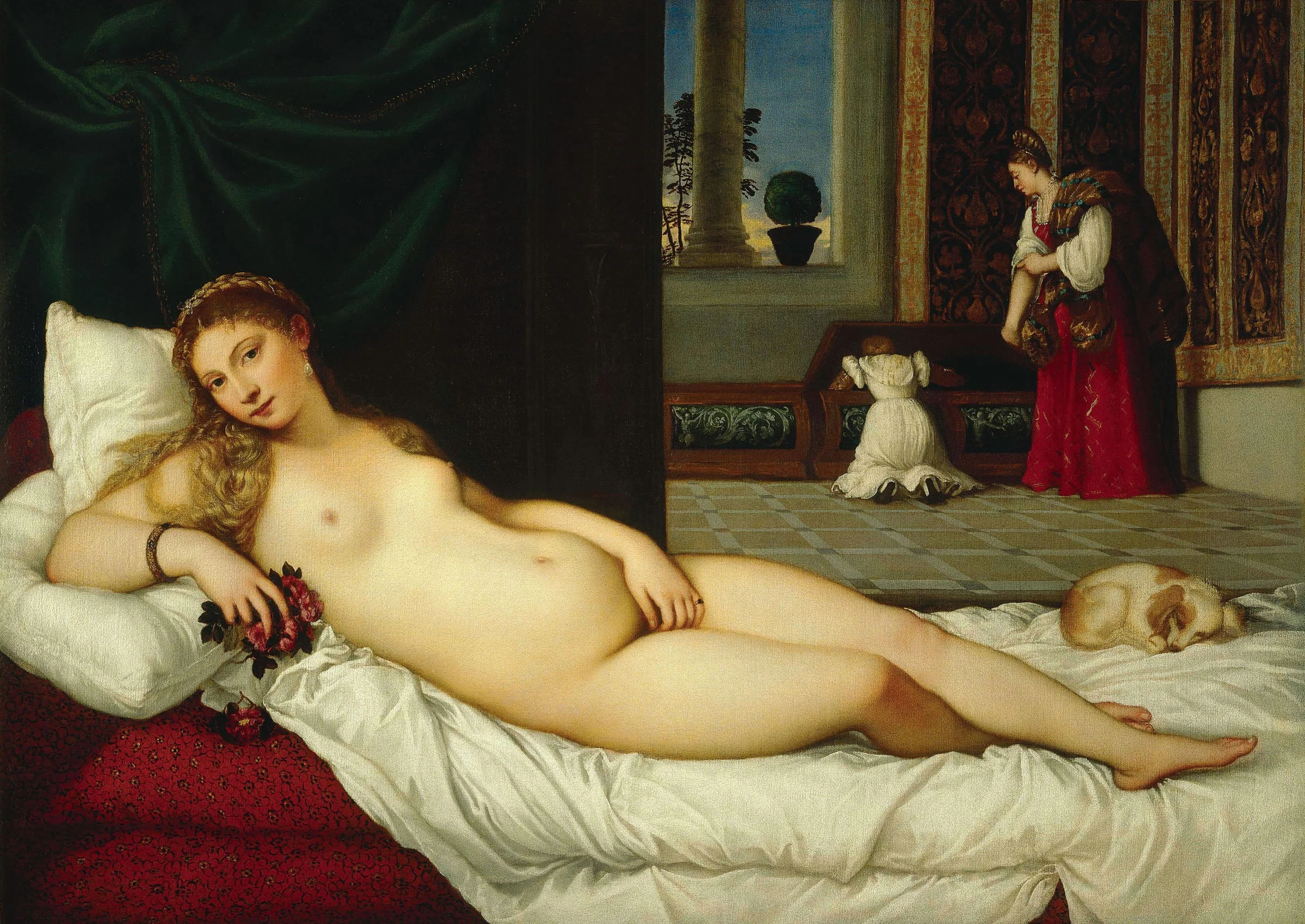 Detail 1
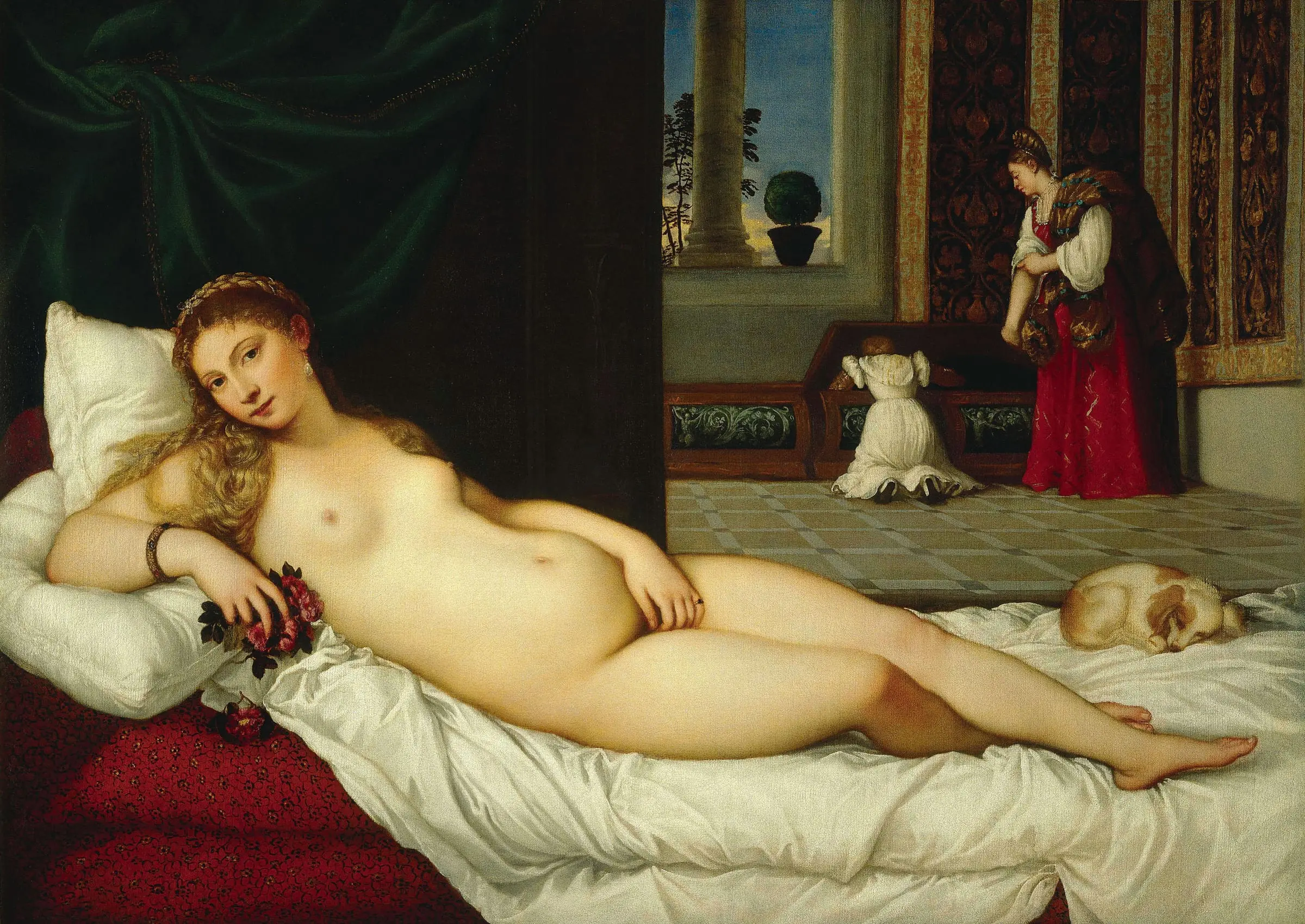
The calm gaze
The woman looks directly out of the painting. Her openness transformed the sleeping goddess of earlier art into a conscious, present woman.
The roses
In her right hand she holds a small bouquet of roses, flowers of Venus and of love. Some of them have fallen onto the sheet. On the window sill in the background stands a pot of myrtle, another plant of Venus and a symbol of constancy in marriage.
Detail 2Roses in her hand
The roses, sacred to Venus, symbolise love and beauty. A few petals have fallen onto the white sheet.
The sleeping dog
At the woman's feet a small spaniel curls up asleep. Dogs were symbols of fidelity, and the sleeping dog suggests a peaceful, intimate home. It has often been read as a sign that the painting celebrates marriage and married love rather than merely sensual beauty.
Detail 3The sleeping spaniel
The little dog sleeps curled on the bed, a symbol of fidelity and of a calm domestic scene.
The maids and the chests
In the background, in a room with a tiled floor and tapestries, two servants search in a pair of cassoni, the painted wedding chests in which brides kept their trousseau. One kneels and looks into a chest, while the other stands with a dress over her shoulder. They reinforce the idea of a marriage painting: the young wife waiting while her clothes are prepared.
Detail 4Maids at the wedding chests
Two servants look for clothes in the cassoni, wedding chests. The detail points to the theme of marriage.
A model for centuries
The Venus of Urbino became the model for the reclining nude in Western art. Velázquez's Rokeby Venus, Goya's Maja and Ingres's Odalisques all respond to it. In 1863 Édouard Manet, who had copied it in Florence, transformed it into Olympia, replacing the dog with a black cat and the maids with a servant bringing flowers. The writer Mark Twain, visiting the Uffizi in 1880, called it the most indecent picture in the world, which only added to its fame.
Seeing the Venus of Urbino
The painting measures about 1.2 by 1.65 metres. It entered the Medici collections in 1631 through the marriage of Vittoria della Rovere and has been in the Uffizi Gallery in Florence since the eighteenth century.
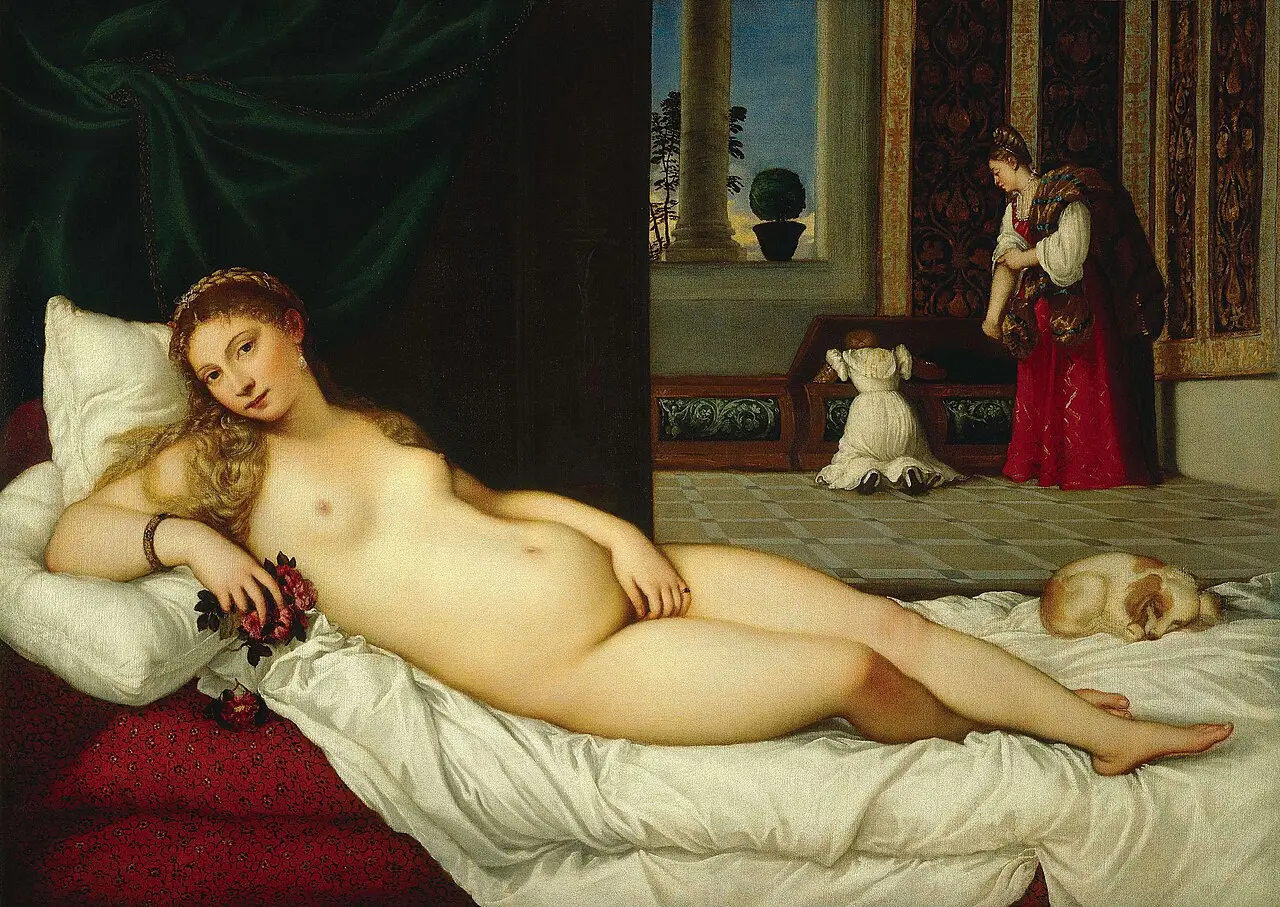
Own a hand-painted copy
Venus of Urbino
Painted by hand in oil on canvas, any size. Free worldwide shipping.
From $299 — Make it yours.Frequently asked questions
Who painted the Venus of Urbino?
Titian, the great Venetian Renaissance painter, painted it in 1538.
Why is it called the Venus of Urbino?
It was bought by Guidobaldo della Rovere, who soon became Duke of Urbino.
What do the dog and the roses mean?
The sleeping dog symbolises fidelity, and the roses are flowers of Venus, symbols of love; both suggest a celebration of marriage.
Where is the Venus of Urbino?
It is in the Uffizi Gallery in Florence.
Sources and further reading
- Uffizi Galleries, collection notes on the Venus of Urbino
- Rona Goffen, Titian's Women (1997)
- Mark Twain, A Tramp Abroad (1880)
