


Listen to this article
0:00 / 3:37 · Read by ArtLogia
Under a great sky of clouds, the city of Delft lies across the water, its roofs glistening, a church tower lit by sudden sunshine. Painted around 1660–1661, Vermeer's View of Delft is one of the most celebrated cityscapes ever made.
In this article
Vermeer's city
Johannes Vermeer was born in Delft in 1632, lived there all his life and died there in 1675. View of Delft is one of only two cityscapes he is known to have painted, the other being The Little Street. He painted it around 1660–1661 from an upper floor of a house on the far side of the Kolk, a harbour just south of the city walls.
The view shows the southern side of Delft across the water: the brick walls, the Schiedam Gate with its clock and the Rotterdam Gate with its twin towers, the roofs of the houses and, behind them, the towers of the city's churches.
The sky
More than half of the painting is sky, filled with heavy grey and white clouds. A dark cloud hangs over the foreground and casts a shadow over the water and the nearest buildings, while sunlight breaks through further away and lights up the city behind. The contrast of shadow and light gives the scene the fresh feeling of a moment just after rain.
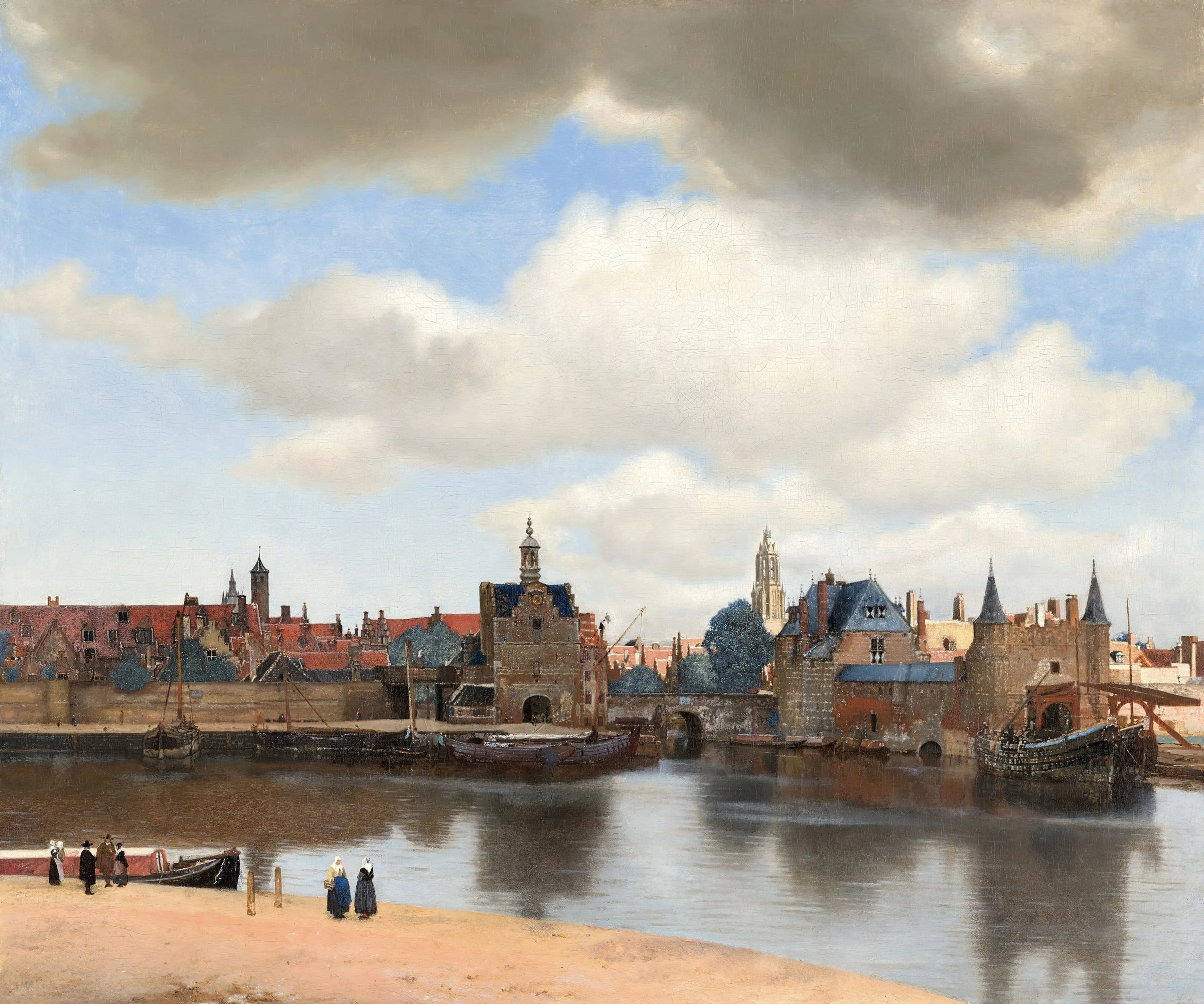 Detail 1
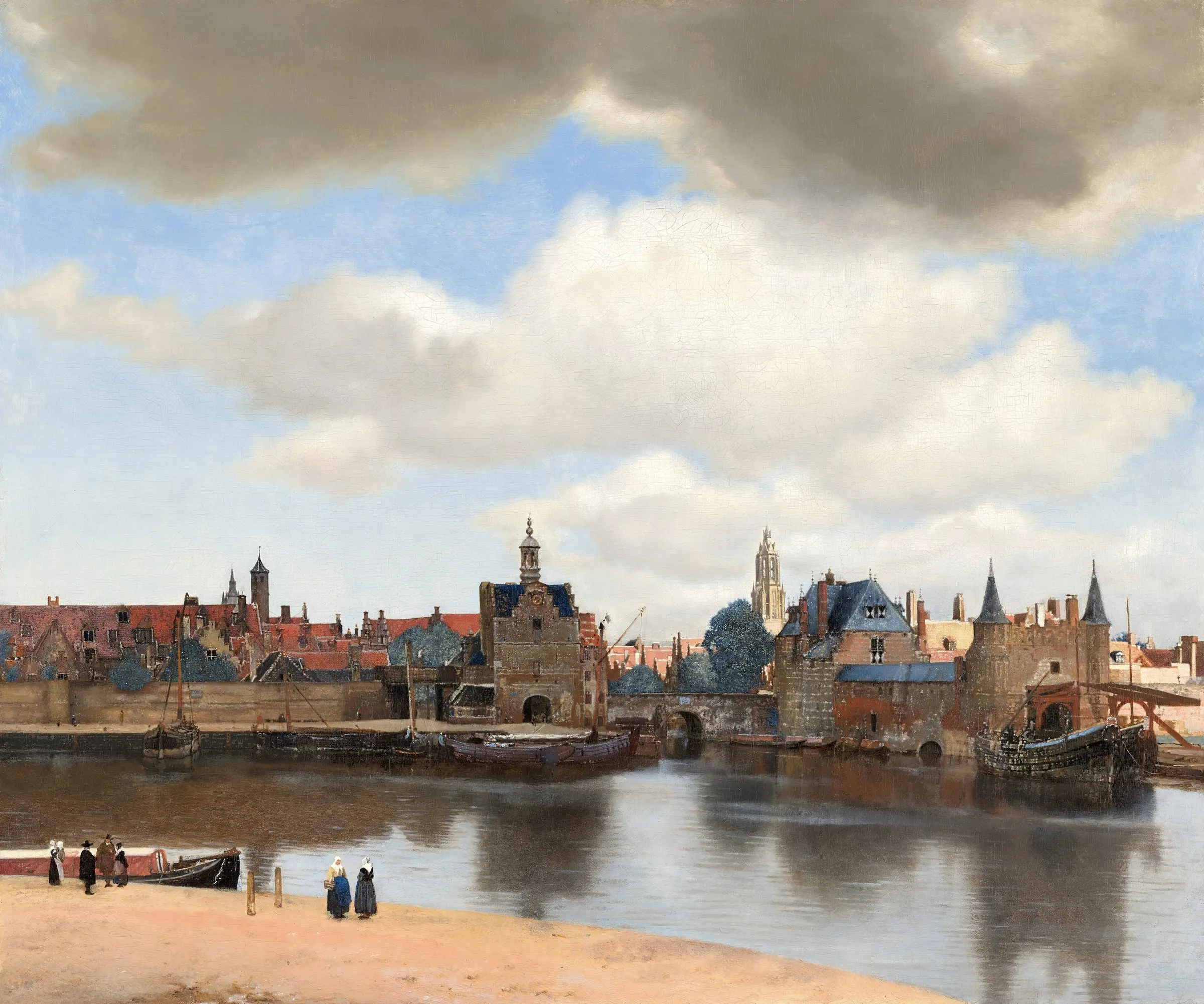
A sky after the rain
Great clouds move across the sky, casting the foreground into shadow. The light that breaks through behind them gives the city its glow.
The sunlit tower
The brightest point of the painting is the tower of the Nieuwe Kerk, the New Church, lit by sunshine in the distance. The church was the burial place of William of Orange, the father of the Dutch nation, so its tower carried a strong patriotic meaning. Vermeer adjusted the view slightly, shifting buildings to create a balanced composition, as research comparing it with old maps has shown.
Detail 2The Nieuwe Kerk
The tower of the New Church shines in pale yellow light behind the darker rooftops, the most luminous point of the view.
The gates and the walls
In the centre, the Schiedam Gate with its clock shows the time as about ten past seven in the morning. To the right, the Rotterdam Gate's two towers rise above the water with boats moored in front. Vermeer painted the brickwork and the roofs with small, grainy dots of paint, mixing sand into some layers, to suggest the texture of the walls and the sparkle of light on wet surfaces.
Detail 3The Schiedam Gate
The gate with its clock face marks the time as early morning. The roofs and bricks shimmer with tiny dots of light-coloured paint.
People on the shore
On the sandy shore in the foreground, small groups of people stand and talk near a moored boat, waiting perhaps for the ferry. They are tiny compared with the city, but their bright clothes catch the eye and give the scene its human scale.
Detail 4Figures on the quay
A few townspeople wait on the sandy bank, their small figures painted with just a few touches of colour.
Proust's little patch of yellow wall
In Marcel Proust's novel In Search of Lost Time, the writer Bergotte goes to see View of Delft at an exhibition. Gazing at "a little patch of yellow wall" in the painting, he realises that he should have written as Vermeer painted, and he dies in front of it. Proust himself had seen the painting in The Hague in 1902 and called it the most beautiful painting in the world. Readers still debate which patch of wall he meant.
Seeing View of Delft
The painting measures about 97 by 116 centimetres and is in the Mauritshuis in The Hague, which bought it at auction in 1822.
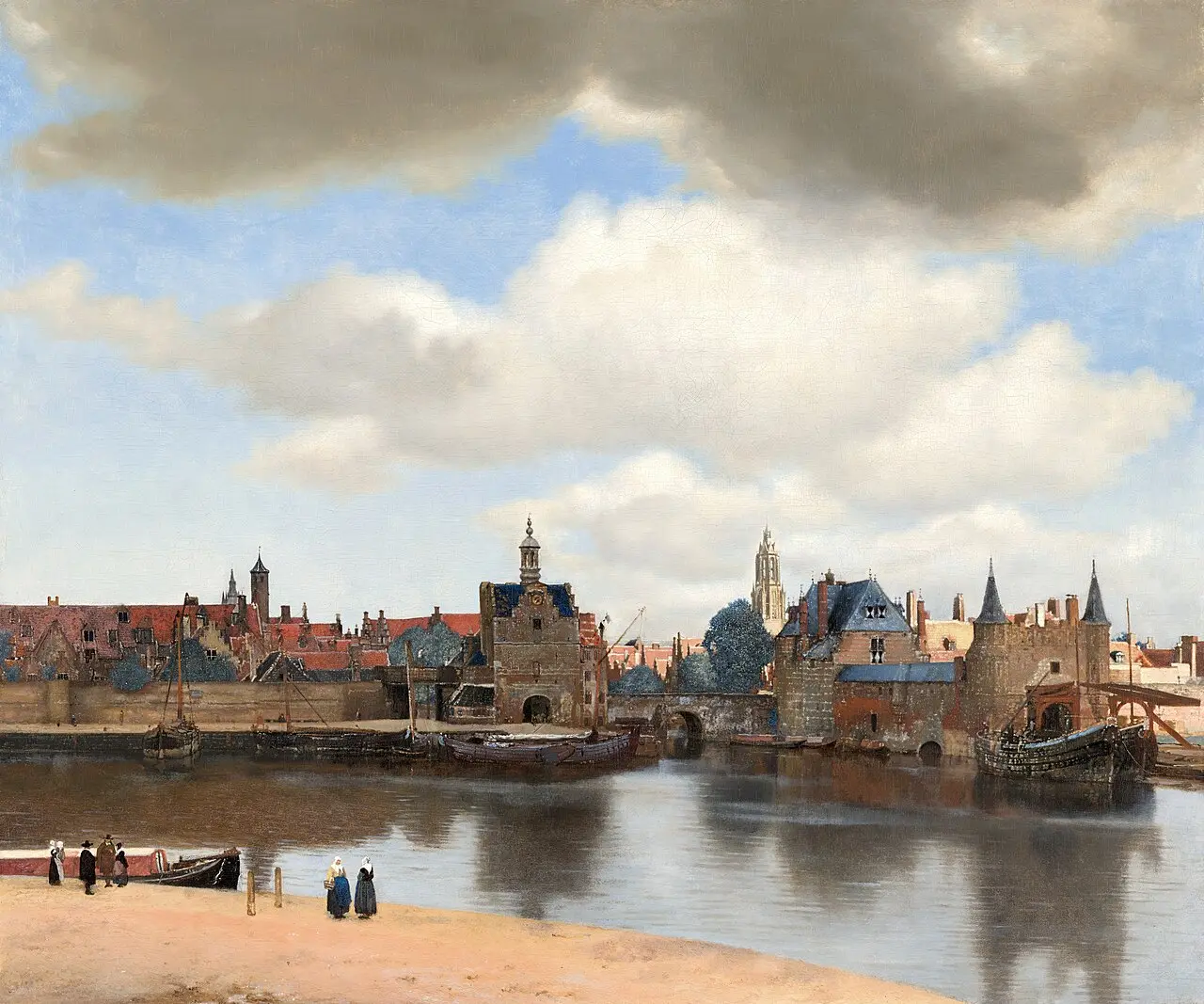
Own a hand-painted copy
View of Delft
Painted by hand in oil on canvas, any size. Free worldwide shipping.
From $299 — Make it yours.Frequently asked questions
Where was View of Delft painted from?
Vermeer painted the view from the south side of the Kolk harbour, looking north across the water at the city's southern walls and gates.
What is the bright tower in View of Delft?
It is the tower of the Nieuwe Kerk, the New Church, where William of Orange was buried.
What is the "little patch of yellow wall"?
It is a detail described by Marcel Proust in his novel In Search of Lost Time, where the writer Bergotte dies while gazing at the painting.
Where is View of Delft?
It is in the Mauritshuis in The Hague.
Sources and further reading
- Mauritshuis, collection notes on View of Delft
- Walter Liedtke, Vermeer: The Complete Paintings (2008)
- Marcel Proust, The Captive (1923)
