


Listen to this article
0:00 / 3:47 · Read by ArtLogia
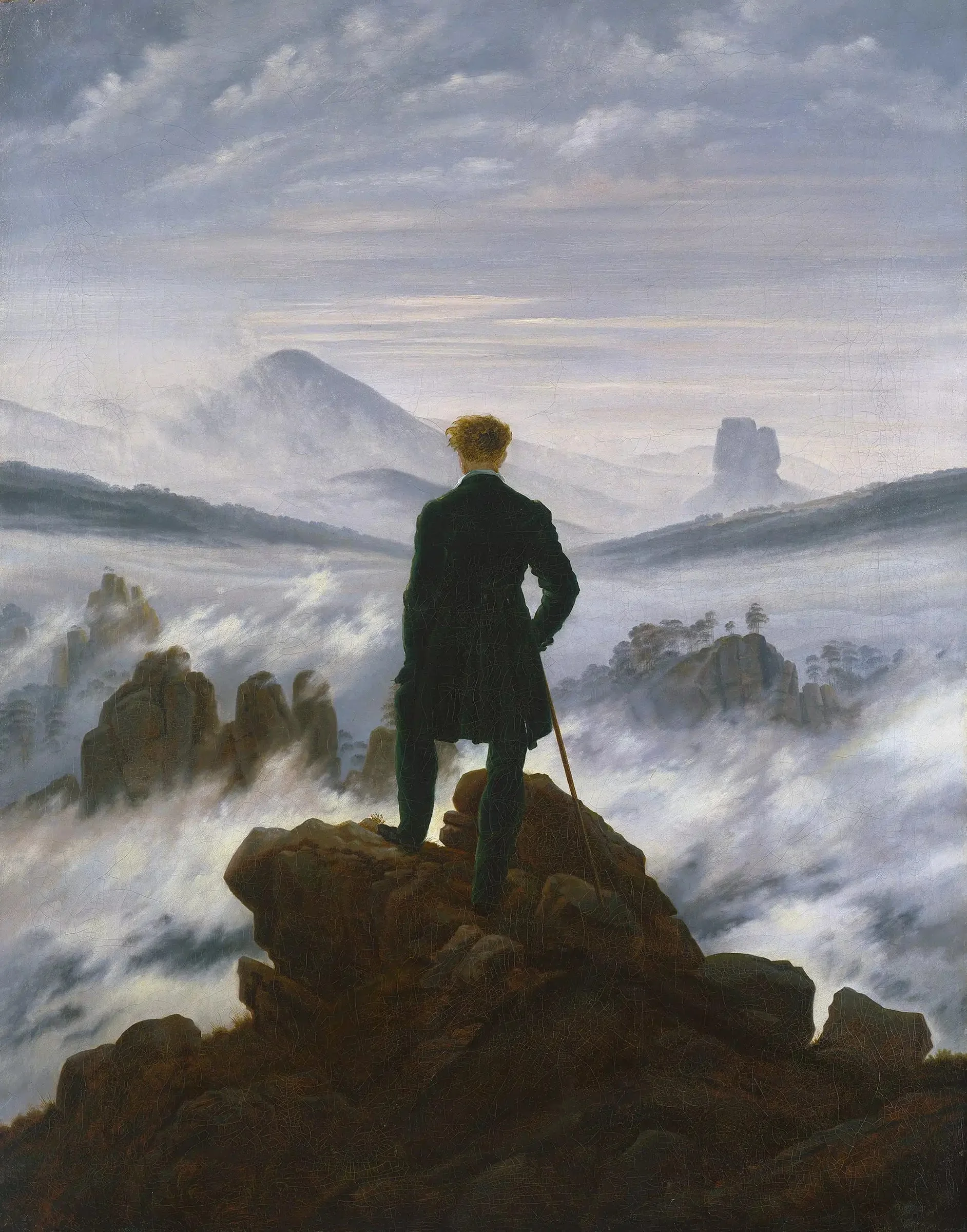
A man in a dark green coat stands on a rocky summit, his back to us, looking out over a sea of fog from which mountain peaks emerge. Caspar David Friedrich's painting of around 1817 has become the defining image of Romanticism.
In this article
The image of Romanticism
Caspar David Friedrich painted Wanderer above the Sea of Fog around 1817 in Dresden, where he lived and worked for most of his life. It shows a man standing on a rocky outcrop high above a landscape filled with fog. Mountain peaks and ridges rise out of the mist, and far away, a mountain emerges on the horizon under a pale sky.
Few paintings have been reproduced as often. It appears on the covers of books of philosophy and poetry, on posters and in films, as a symbol of the individual facing nature, of contemplation and of the Romantic soul. Yet the painting was almost forgotten for a century after Friedrich's death and only entered the Hamburger Kunsthalle in 1970.
The figure seen from behind
The man stands at the very centre of the painting, his back turned to us. Germans call this kind of figure a Rückenfigur, a figure seen from behind, and it is the signature of Friedrich's art. Because we cannot see his face, we cannot know what he feels; instead we are invited to stand in his place and look with him. The painting becomes an experience rather than a story.
 Detail 1
The windswept hair
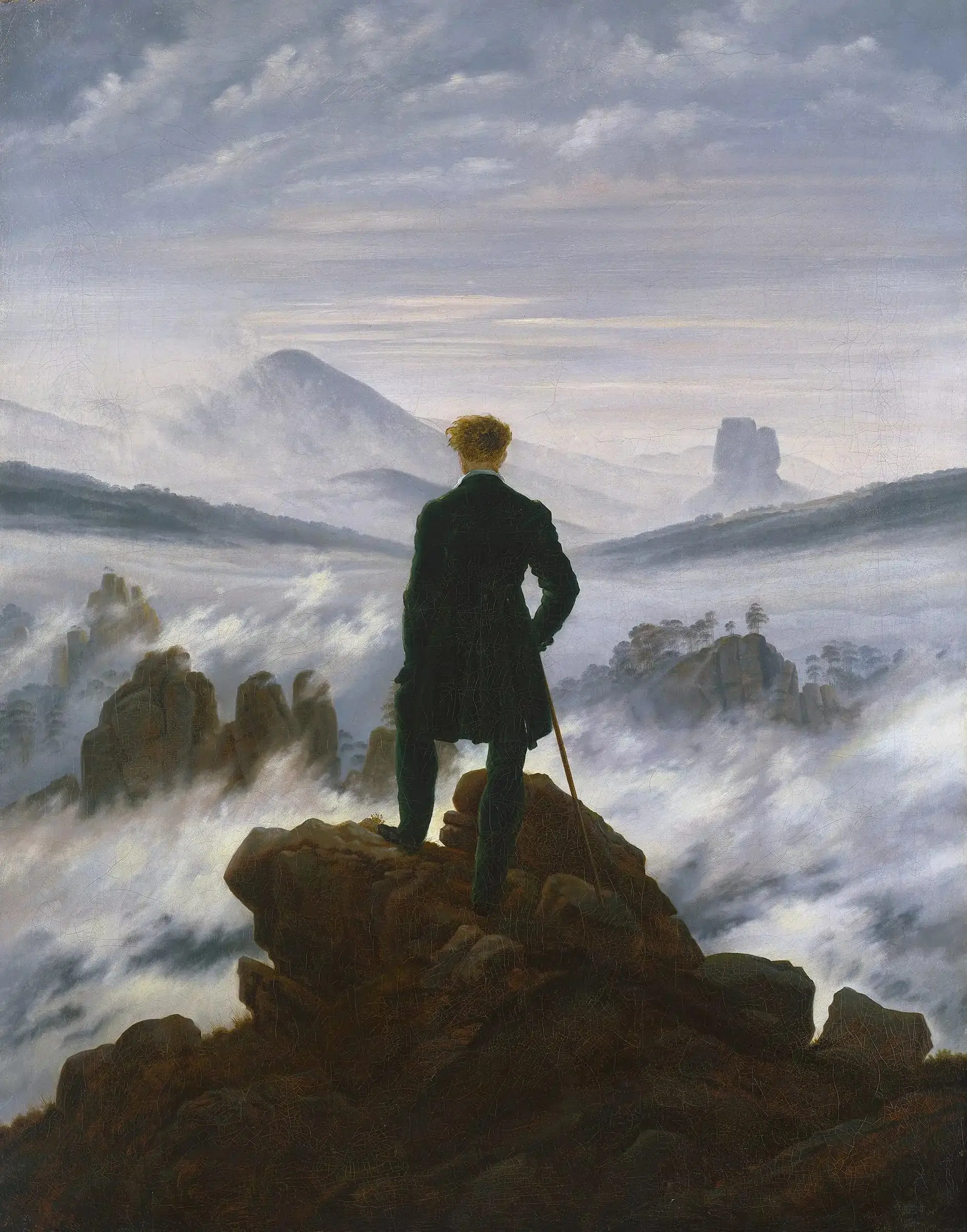
The wanderer's red-blond hair is blown by the wind. We never see his face, so we share his view instead of studying his expression.
He wears a dark green frock coat and holds a walking stick, the clothes of a city gentleman rather than a mountaineer. The green coat was the costume worn by German volunteers in the wars of liberation against Napoleon, and some historians see in the figure a patriotic memorial, perhaps to an officer who died in the war.
Detail 2The walking stick
The wanderer rests on his stick, one foot on a higher rock. His stance is steady and calm, at the very edge of the abyss.
A composite landscape
The landscape looks real, but it is put together from several places. Friedrich made drawings in the Elbe Sandstone Mountains south of Dresden, in what is now Saxon Switzerland, and combined them in the studio. The rocks in the foreground, the ridges in the middle distance and the distant mountain, often identified as the Zirkelstein or the Rosenberg, come from different viewpoints.
Detail 3Peaks above the mist
Distant ridges emerge from the fog in pale blue-grey. Friedrich assembled them from studies made in different places in the Elbe Sandstone Mountains.
The sea of fog
The fog fills the valleys and hides everything below the summits, so the world seems to dissolve into a white, shapeless sea. Friedrich painted it with thin, pale layers that blur the edges of the rocks. The effect is what writers of the time called the sublime: a feeling of awe, even fear, before the immensity of nature, which makes the individual feel small and yet uplifted.
Detail 4Rocks dissolving into fog
In the foreground the dark rocks fade into mist. The contrast between the solid summit and the formless fog below gives the painting its sense of height.
What does it mean?
Friedrich was a deeply religious man, and for him landscape was a way to speak about the spiritual. The wanderer can be seen as a person at a turning point, contemplating the unknown future; as a believer before the infinity of God's creation; or as the modern individual alone with his thoughts. Friedrich himself said that the painter should paint not only what he sees before him but also what he sees within him.
Seeing the original
The painting measures about 95 by 75 centimetres and is in the Hamburger Kunsthalle in Hamburg, Germany, in the galleries of German Romantic painting.
Own a hand-painted copy
Wanderer above the Sea of Fog
Painted by hand in oil on canvas, any size. Free worldwide shipping.
From $299 — Make it yours.Frequently asked questions
Who painted Wanderer above the Sea of Fog?
The German Romantic painter Caspar David Friedrich painted it around 1817.
Why is the figure seen from behind?
The Rückenfigur, or figure seen from behind, invites viewers to stand in his place and share his view, a device Friedrich often used.
Where is the landscape in Wanderer above the Sea of Fog?
It is a composite of studies Friedrich made in the Elbe Sandstone Mountains near Dresden.
Where is Wanderer above the Sea of Fog?
It is in the Hamburger Kunsthalle in Hamburg.
Sources and further reading
- Hamburger Kunsthalle, collection notes on Wanderer above the Sea of Fog
- Joseph Leo Koerner, Caspar David Friedrich and the Subject of Landscape (1990)
- Werner Hofmann, Caspar David Friedrich (2000)
