

Listen to this article
0:00 / 3:12 · Read by ArtLogia
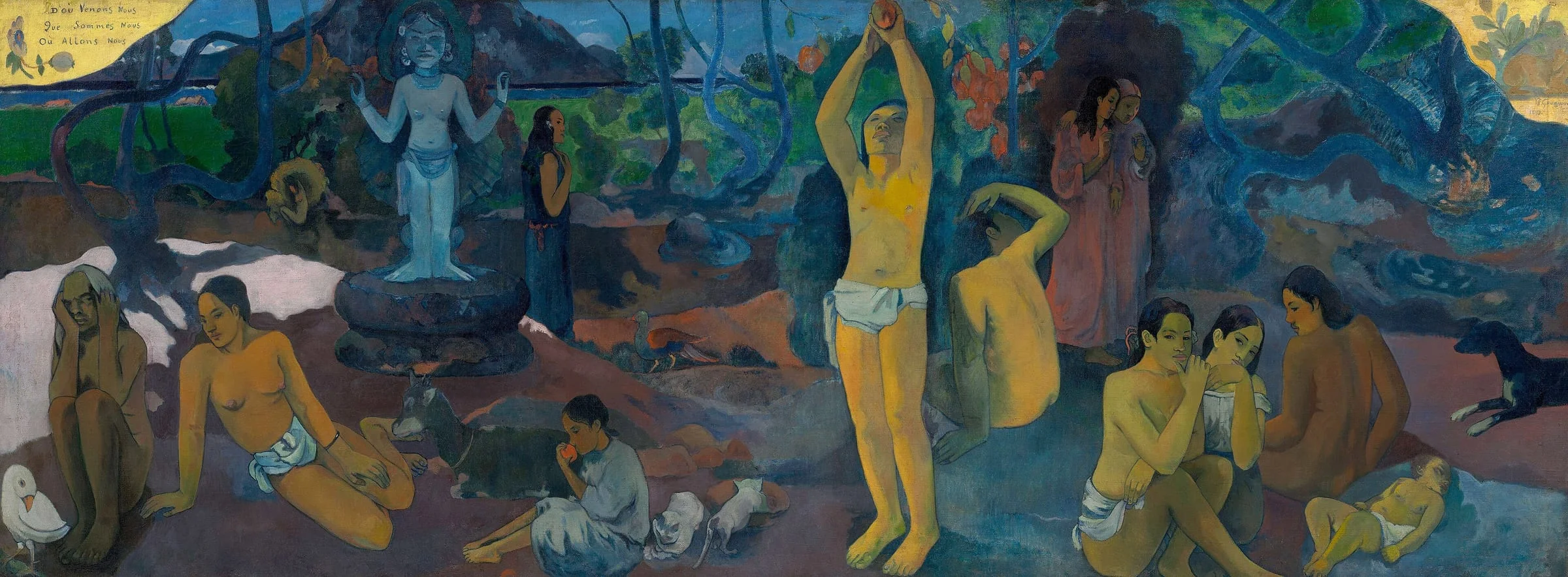
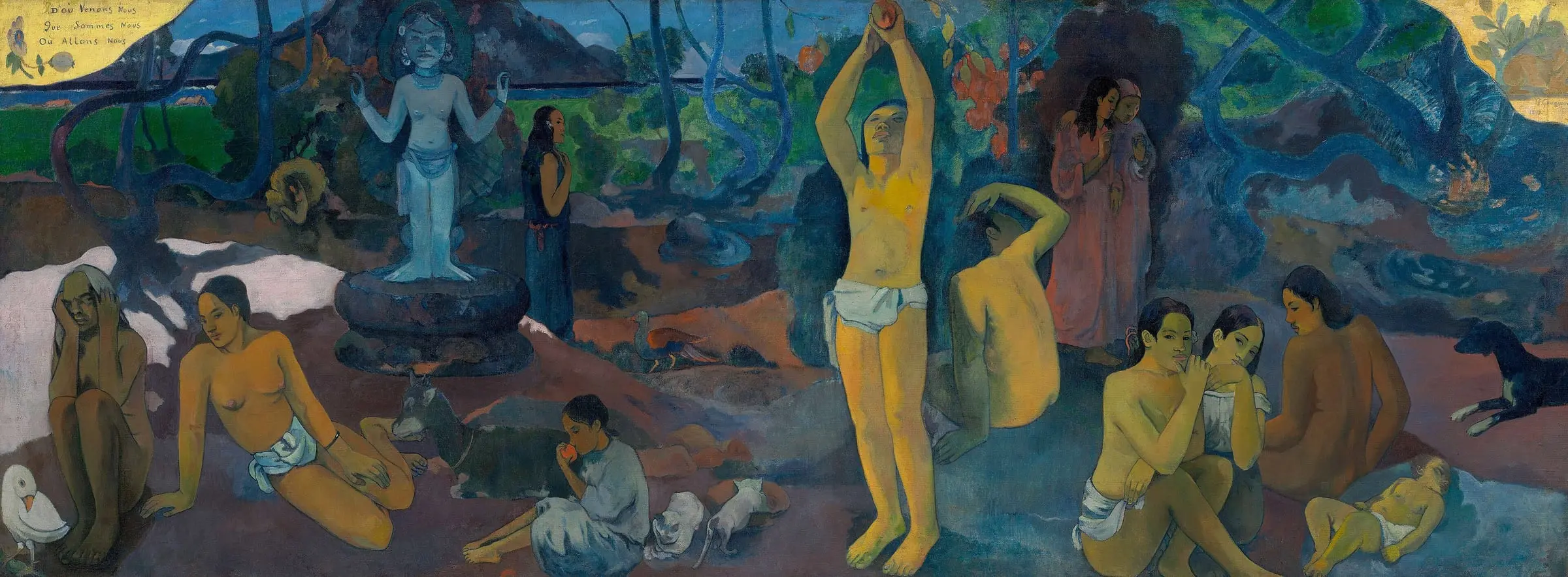
Across a frieze of figures in a Tahitian landscape, life unfolds from a sleeping baby on the right to an old woman near death on the left, under the gaze of a blue idol. Paul Gauguin painted this vast canvas in 1897, believing it would be his last work.
In this article
A painting in the face of death
In 1897 Paul Gauguin was living in Tahiti, ill, poor and in despair. He had learned of the death of his favourite daughter, Aline, in France. He decided to paint a great final work, a philosophical testament, before ending his life. He worked on it for about a month, then, according to his letters, attempted suicide with arsenic. He survived and lived until 1903.
He wrote the title in French in the upper left corner: D'où venons-nous? Que sommes-nous? Où allons-nous? Where do we come from? What are we? Where are we going?
Reading from right to left
Gauguin explained in a letter to his friend Daniel de Monfreid that the painting should be read from right to left. On the right, a sleeping baby lies on the ground with three young women nearby: the beginning of life. In the centre, a young figure picks fruit from a tree: the experience of life. On the left, an old woman near death sits with her head in her hands, accepting her fate.
 Detail 1
The sleeping baby
On the right, a baby sleeps near three seated women, the beginning of life according to Gauguin's own reading of the painting.
The figure picking fruit
At the centre stands a young figure reaching up to pick a fruit from a tree, a pose that recalls the Biblical Eve and the fruit of knowledge. The figure is the tallest in the painting and divides it in two.
Detail 2Picking the fruit
The central figure stretches up to pick fruit, a symbol of the experience of life and perhaps of the knowledge that leads to awareness of death.
The blue idol
In the left background stands a blue statue of a Polynesian deity, its arms raised, which Gauguin described as "the Beyond". The idol seems to watch over the scene, a presence of the spiritual world.
Detail 3The blue idol
A blue statue with raised arms stands in the landscape. Gauguin called it "the Beyond", a figure of the spiritual world.
The old woman
At the far left, an old woman crouches with her hands over her ears, resigned. Beside her, a strange white bird holds a lizard in its claws, which Gauguin said represented "the futility of vain words".
Detail 4The old woman
Near the left edge, an old woman sits with her head in her hands, close to death. A white bird holding a lizard stands at her feet.
The title in the corner
The title and Gauguin's signature are painted in a yellow corner at the upper left, as if on a fresco whose corners had faded. The opposite corner is also yellow, giving the painting the look of an old wall painting.
Detail 5The title in the corner
The three questions are written in French on a yellow ground in the upper left corner, like an inscription on an old fresco.
Seeing the painting
The canvas is about 1.4 by 3.8 metres, Gauguin's largest painting. It is in the Museum of Fine Arts in Boston.
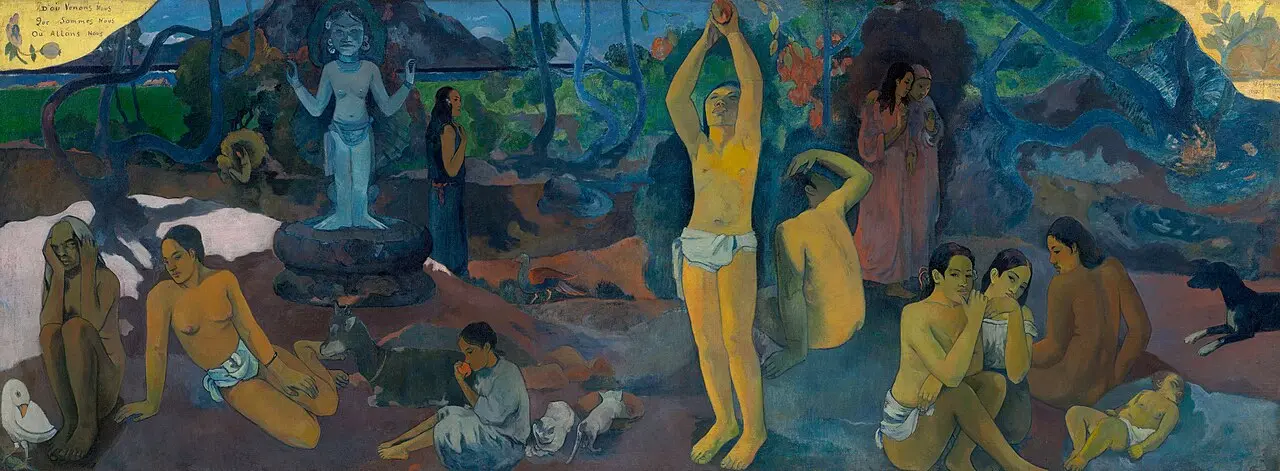
Own a hand-painted copy
Where Do We Come From? What Are We? Where Are We Going?
Painted by hand in oil on canvas, any size. Free worldwide shipping.
From $299 — Make it yours.Frequently asked questions
How should Where Do We Come From? be read?
Gauguin said it should be read from right to left, from a sleeping baby to an old woman near death.
Why did Gauguin paint it?
He painted it in 1897 in Tahiti as a final testament, in deep despair after the death of his daughter.
What is the blue figure?
It is a Polynesian idol, which Gauguin described as representing "the Beyond".
Where is Where Do We Come From? What Are We? Where Are We Going?
It is in the Museum of Fine Arts in Boston.
Sources and further reading
- Museum of Fine Arts, Boston, collection notes on Where Do We Come From? What Are We? Where Are We Going?
- Paul Gauguin, letter to Daniel de Monfreid, February 1898
- George T. M. Shackelford and Claire Frèches-Thory, Gauguin Tahiti (2003)
