


Listen to this article
0:00 / 3:35 · Read by ArtLogia
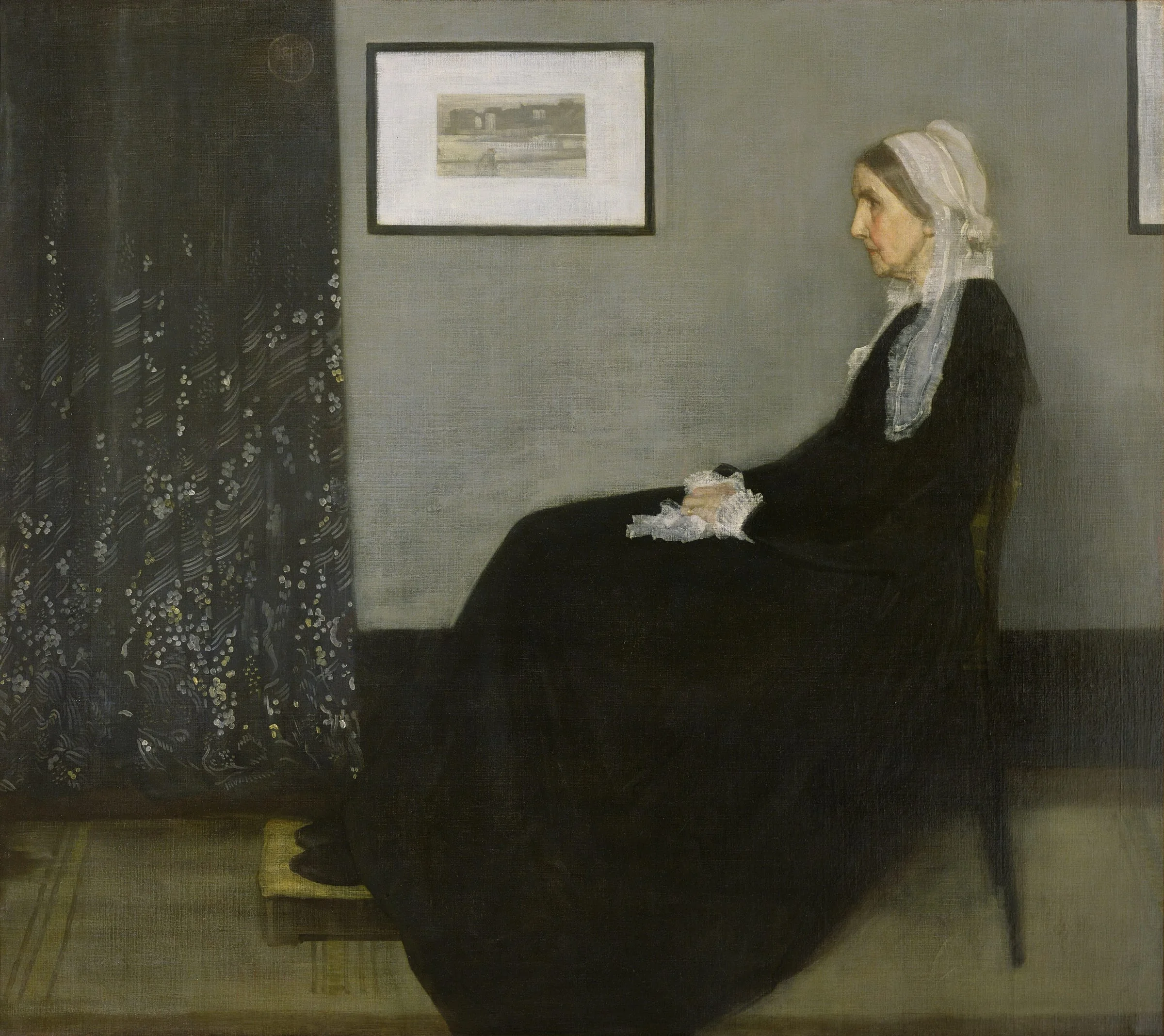
An elderly woman in black sits in profile against a grey wall, her hands folded in her lap, a white lace cap on her head. James McNeill Whistler painted his mother in 1871 and called it Arrangement in Grey and Black No. 1; it became one of the most famous American paintings.
In this article
A portrait as an arrangement
James McNeill Whistler, an American painter living in London, painted his mother, Anna McNeill Whistler, in 1871. According to family tradition, the model who was supposed to pose for him failed to arrive, and his mother agreed to take her place. She was too tired to stand, so he painted her seated.
He called the painting Arrangement in Grey and Black No. 1. Whistler believed that art should exist for its own beauty, like music, and he gave his paintings musical titles: arrangements, harmonies, symphonies, nocturnes. He wrote that the public was not interested in the identity of the portrait, only in its arrangement of colours.
The profile
Anna Whistler sits in strict profile, facing left, her face calm and serious under a white lace cap whose ribbons fall over her shoulders. She was a devout, strong-willed woman who had moved from America to London to live with her son.
 Detail 1
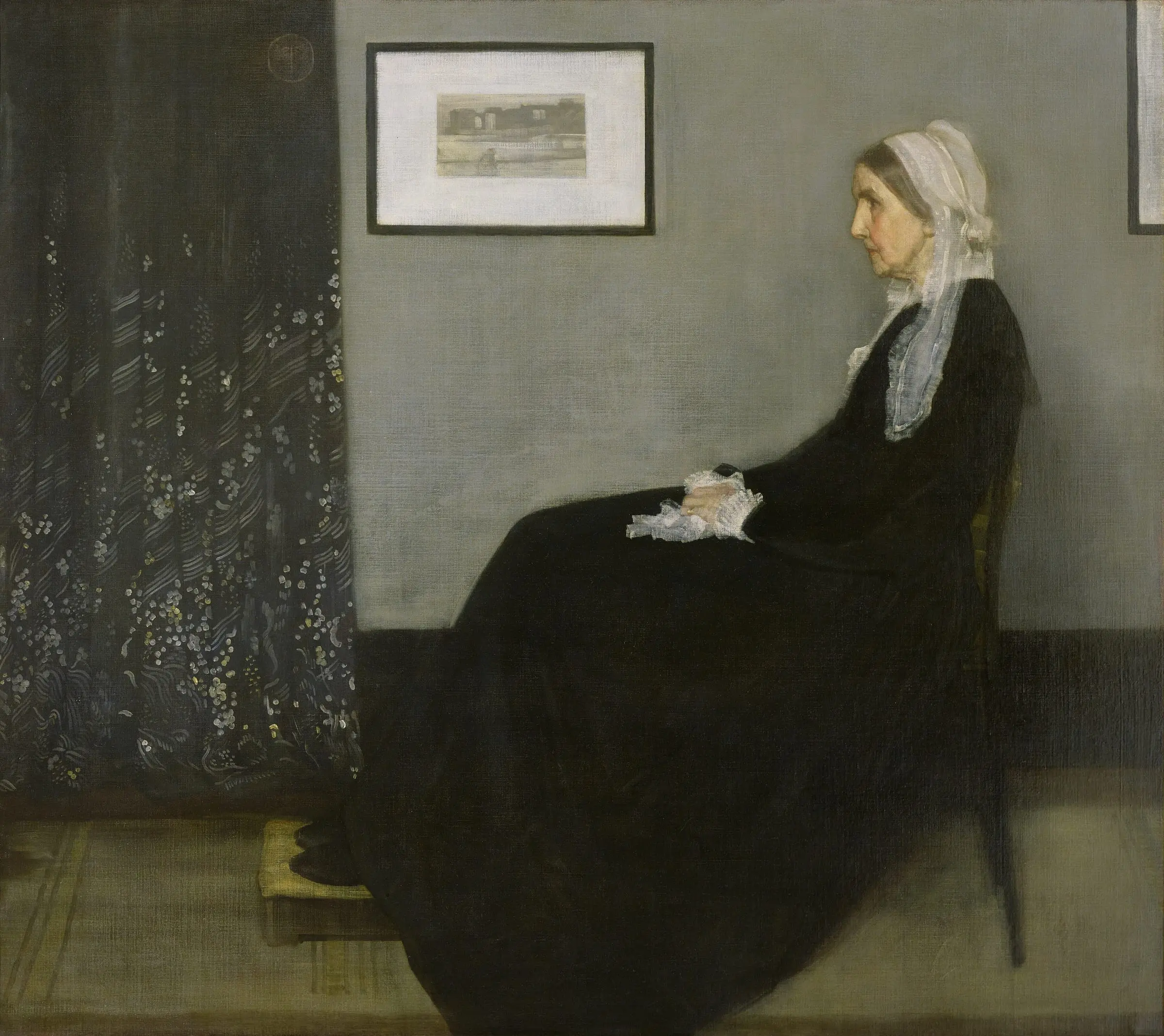
A calm profile
Anna Whistler's face is seen in strict profile beneath her white lace cap, serene and dignified.
The hands
Her hands rest in her lap holding a white lace handkerchief, the only bright note in the lower half of the painting besides the face. The stillness of the pose expresses patience and quiet strength.
Detail 2Hands and handkerchief
Her folded hands hold a white lace handkerchief, a small point of light in the dark mass of her dress.
Grey and black
The composition is built from a few simple rectangles: the grey wall, the black dress, the dark curtain on the left, the framed picture on the wall and the floor. The colours are restricted to greys, blacks and whites. This simplicity was influenced by Japanese prints, which Whistler collected.
Detail 3The framed etching
On the wall hangs one of Whistler's own etchings of the Thames, Black Lion Wharf, in a black frame. It adds a rectangle to the abstract composition.
The curtain
On the left, a dark curtain patterned with small flowers and leaves frames the scene, inspired by Japanese textiles. It balances the dark figure on the right.
Detail 4The patterned curtain
A dark curtain with delicate floral patterns hangs on the left, reflecting Whistler's love of Japanese art.
An American icon
The painting was bought by the French state in 1891, the first work by an American painter to enter the national collections. During the Great Depression it toured the United States, and in 1934 it appeared on a US postage stamp for Mother's Day. It became a symbol of motherhood and of American values, though it was painted in London and hangs in Paris.
Art for art's sake
Whistler was one of the leading voices of the Aesthetic Movement, which held that art should exist for beauty alone, without moral or narrative purpose. He compared painting to music, which can move us through harmonies of sound without telling a story. This is why he insisted that his mother's portrait was an arrangement of colours and shapes. In 1878 his views led to a famous libel trial against the critic John Ruskin, who had accused him of flinging a pot of paint in the public's face with one of his Nocturnes. Whistler won the case but was awarded only a farthing in damages and was ruined by the legal costs. His mother's portrait remains his most famous expression of these ideas.
Seeing Whistler's Mother
The painting measures about 1.44 by 1.62 metres and is in the Musée d'Orsay in Paris.
Own a hand-painted copy
Whistler's Mother
Painted by hand in oil on canvas, any size. Free worldwide shipping.
From $299 — Make it yours.Frequently asked questions
What is the real title of Whistler's Mother?
Its real title is Arrangement in Grey and Black No. 1.
Who is the woman in Whistler's Mother?
She is Anna McNeill Whistler, the painter's mother.
Why is it in Paris?
The French state bought it in 1891, and it is now in the Musée d'Orsay.
Where is Whistler's Mother?
It is in the Musée d'Orsay in Paris.
Sources and further reading
- Musée d'Orsay, collection notes on Arrangement in Grey and Black No. 1
- Margaret F. MacDonald (ed.), Whistler's Mother: An American Icon (2003)
- James McNeill Whistler, The Gentle Art of Making Enemies (1890)
